
By Ignatius Chukwu
Resource experts from agric projects in Nigerian have begun sittings in Port Harcourt to create solutions and buffers against the harms of climate change.
Details:
The federal government has teamed up with the International Fund for Agricultural Development (IFAD) to wage war against the harms of climate change.
The war is waged within the context and size of 59 countries in Africa and Asia to rescue farming and food security.
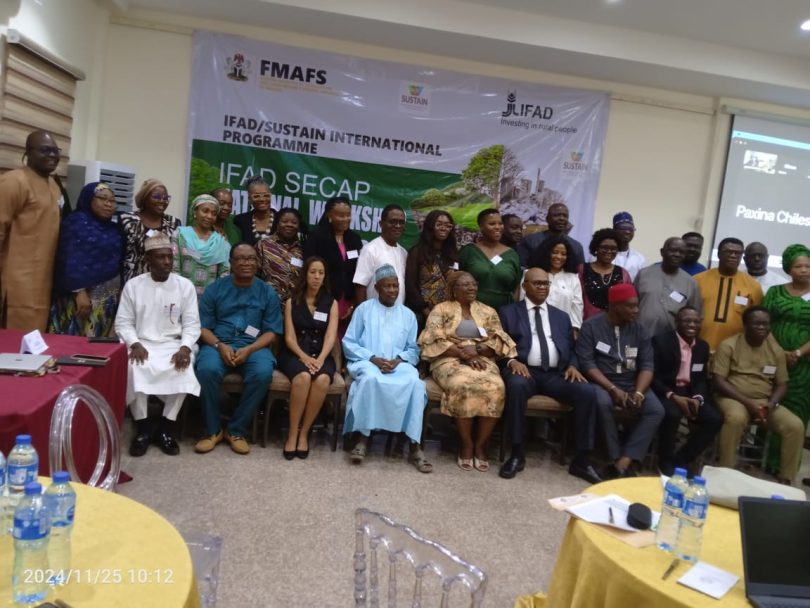
The FG and IFAD disclosed the plans in Port Harcourt, Rivers State, South-South Nigeria, where a workshop is holding for states of Nigeria on various agric projects under the FG/IFAD purview on best strategies to wage the climate change wars.
IFAD has partnership with the FG through the Federal Ministry of Agriculture & Food Security with which they created a special purpose vehicle called the Livelihood Improvement Family Enterprise in the Niger Delta (LIFE-ND) which has the Niger Delta Development Commission (NDDC) as a partner. The war-chest of the LIFE-ND is $90m (N135bn by today’s rate) to focus on nine states of the oil region with the NDDC contributing $30m.
To activate the rescue efforts, the partners mounted what the ‘IFAD Social, Environmental, and Climate Assessment Procedures (SECAP) Training’ in Port Harcourt, Nigeria with some of the resource persons drawn from some other parts of Africa.
Giving insights, Engr Abiodun Sanni (PhD), the
National Project Coordinator, FGN/NDDC/IFAD-assisted LIFE-ND, said at Villa Tuscana Luxe Hotel in the GRA 2 area of the Garden City that the Project recognizes that sustainable livelihoods are intrinsically tied to a healthy environment and the ability of communities to adapt to the challenges posed by climate change.
He mentioned various strategies already in existence to rescue farming in Nigeria such as collaboration with NIMET for automated weather stations; Environmental and Social Management Plans (ESMPs); and Sensitization and Capacity Building on Climate Mainstreaming.
Under this, he said, the LIFE-ND has sensitized and built the capacity of over 26,470 incubatees and 966 incubators on environmental and climate change mainstreaming. “This initiative has fostered a deeper understanding and appreciation among participants for adhering to environmental guidelines and climate protocols, laying a solid foundation for sustainable development in the region.”
He also mentioned ‘Seasonal Climate Prediction (SCP) Training and Crop Calendar Development which he said has trained over 400 participants, including incubatees incubators, and farmers’ associations, equipping them with knowledge on optimal farming timelines and weather forecasting for enhanced yield and profitability.
The other scheme he said is the ‘Bio-Gas Digesters for Clean Energy’ whereby he said they designed and produced bio-gas digesters for 200 beneficiaries in Abia State and 160 beneficiaries in Delta State. “These digesters convert agricultural waste into an alternative clean energy source, offering a practical and eco-friendly solution to rural energy needs.”
He also mentioned ‘Agroforestry and Economic Tree Planting’ to combat deforestation and promote environmental rehabilitation, the project has planted over 22,817 agroforestry and economic trees in 200 communities along rehabilitated roads at processing centres, incubation sites, schools, and health centers. This initiative not only restores ecological balance but also provides economic benefits to local communities.
This leads to what he called ‘Step-Down Training to Local Governments’ saying this was cascaded to 58 local government desk officers, ensuring that climate-smart practices reach the grassroots level.
These achievements underscore the LIFE-ND Project’s commitment to sustainable development, environmental protection, and climate adaptation. By integrating these initiatives into our core activities, we are empowering communities to build resilience, embrace sustainability, and secure a better future.
In her clarification, IFAD country director, Ms Dede Ekeuue, mentioned various projects so far implemented such as the deployment of solar boreholes and solar dryers as a game-changer in addressing water and post-harvest challenges; soil and water conservation innovations, introduction of biogas digesters for rural energy needs, and use technology to convert agricultural waste such as rice husks and cassava peels into compact, energy-efficient briquettes.
Flagging off the high-powered workshop open, Mr Bukar Musa, the Director, Projects Coordinating Unit, Federal Ministry of Agriculture and Food Security said the ‘SUSTAIN International Initiative Training Programme’ funded by IFAD was to ensure greater compliance with environmental and climate change standards to strengthen the resilience of our agricultural food systems.
He said the programme was for Pacific, East and Southern Africa, and West and Central African regions, adding that the FG would want to seize this opportunity to appreciate the high quality of cooperation with IFAD.
A resource person from University of South Africa, Jenean Pretorius, explained the differences in climate change impacts around Africa saying challenges from Nigeria such as issues of inclusion would be taken to the policy makers to address.
Two participants; Hajiya Hadizat Isah from Niger State, and Dr Uchenna Rowland Onyeazu from Abia State, explained the huge successes so far recorded in implementing agric programmes in the states.
$$