
By Ignatius Chukwu & Blessing Ita
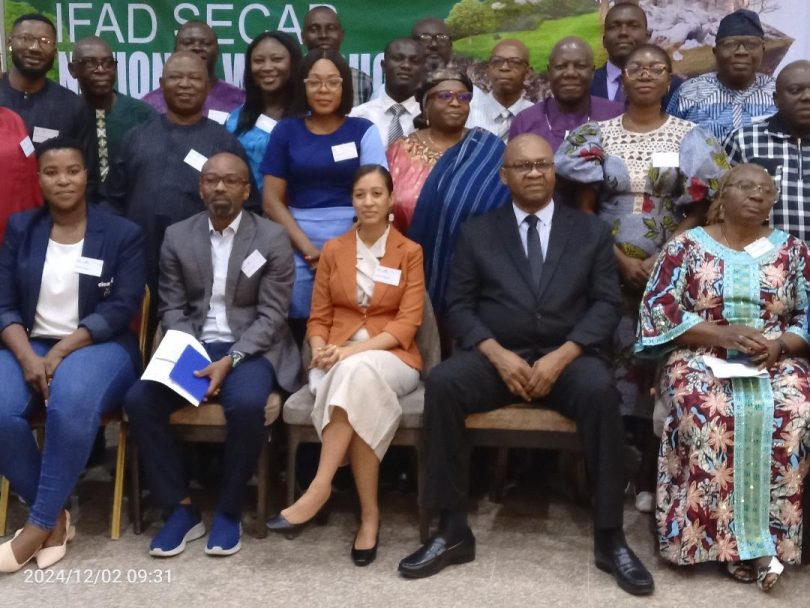
The International Fund for Agricultural Development (IFAD) an arm of the United Nations, has commenced what it calls Cohort 2 of its IFAD/SUSTAIN International programme in Port Harcourt for all of Nigeria.
This comes less than one week after it held the Cohort 1 which was said to target the policy level managers across Nigeria who were mandated to go cascade the knowledge and strategies down the line.
Details:
Now, professionals and experts in environment and agriculture are being trained in Port Harcourt, Rivers State, South-South Nigeria, and are eventually being unleashed into farms and rural areas in Nigeria to fight climate change.
The IFAD-led training is in progress in 59 countries in Africa and Oceania to wage war against hunger and climate change.
The experts are drawn from all the agric projects under the FGN/IFAD to perfect their knowledge on climate change mitigation.
Addressing the participants at Villa Tuscana Luxe in the GRA 2 zone in the Garden City, the IFAD Country Director for Nigeria, Dede Ekeoue, said IFAD is the only international financial institution with a mandate to invest in rural people. “It plays a unique role in transforming food systems working with governments, private sector, development partners and farmers organisations, to deliver greater, more sustainable impacts for small-scale farmers and other key stakeholders involved in food systems.”
She went on: “In line with this unique role of IFAD, the IFAD/ SUSTAIN training programme aims at enhancing the capacity of FGN/IFAD Projects Management Units and Government Agencies to boost agri-food growth through small holder farmers while promoting the successful integration of social climate and environment requirements.”
She said Cohort 1 was made of leaders of projects at the national and state levels who she said successfully leveraged this training to enhance their understanding of the requirements, to Identify strategic areas of actions to further boost compliance with social climate and environment procedures across all FGN-IFAD programmes. In addition, the first cohort committed to continuing the journey of learning through a SECAP community of practice.
She said Cohort 2 is made of specialists mainly environment and climate specialists, rural infrastructure and irrigation specialists, and gender and youth and rural Institutions experts. “Ensuring the integration of Social Environment and Climate Assessment Procedures (SECAP) and Environment, Social Climate Management Plan (ESCMP) across all the project components is critical including your respective areas.”
She urged the experts to make better and bigger investments in social inclusion, environment protection and climate resilience to sustain and scale up the remarkable results the IFAD is achieving in key areas such agro-productivity, light processing, food security and nutrition, linkage of small holder farmers to markets and agro-industries, and growth of farmer-income.”
In his contribution, Dr Abiodun Sanni, an engineer, who is the National Project Coordinator of the Livelihood Improvement Family Enterprises Project in the Niger Delta (LIFE-ND) said the timing marks a significant step forward in the collective efforts to ensure that the initiatives they undertook were not only successful but also sustainable and inclusive.
“As we know, Nigeria, and the Niger Delta region in particular, is home to a unique and diverse ecosystem with communities whose livelihoods are intricately linked to the land, water, and natural resources.
“It is critical, therefore, that our interventions whether they relate to infrastructure, economic development, or social empowerment are designed and implemented with a keen understanding of their social, environmental, and climate impacts to safeguard vulnerable communities, protect our natural resources, and ensure that the benefits of our work are realized in a way that is equitable and sustainable.”
Speaking, Paxina Chilleshe-Toe, Regional Technical Lead, Climate and Environment, IFAD OTD, West and Central Africa Division, Ivory Coast, said the training is expected to see how farming activities affect the environment as well as assess opportunities created.
She said the training would also improve agric resources with better integration of environmental management with better climate change mitigation. “This is being done in seven countries so far, and trainers are able to deliver values through the trainees down the line. The syllabus is suited to each country and the West African region.”
On her own, Jenean Pistorius from Clear AA, Centre for Learning and Evaluations and Results in Anglophone Africa, based in Johannesburg, South Africa, said their work is to support what IFAD is doing across Africa.
She said: “So primarily, what I am responsible for in the centre is capacity strengthening at large within the monitoring and evaluation systems buildings throughout English speaking Africa.”
On how their work affects the real farmers, she said: “Our methodology is to build and enhance the capacity of a project managers to make sure that everything in terms of strategic goals (whether it is farming, whether it’s irrigation, whether it’s livestock) which is that farmer is able to benefit from all of the farms, from all of the resources that IFAD is setting aside.
“So, if the project manager has what he needs in terms of capacity, he can make sure that the project is succeeding and that the farmer is absolutely benefiting in terms of the yields, in terms of the knowledge, in terms of the skills that his family is benefitting.
“So, that’s the theory of change which is that everybody is improving in terms of the skills, ultimately, there must be productivity, there must be enhancement towards the very last person and that’s the farmer.”
On who IFAD reports to, I think that there reports and I think there is a higher body or the board or the UN to review what IFAD is doing.
$$