
By Ignatius Chukwu
Efforts to empower volunteers fighting against sexual and gender-based violence (SGBV) have heightened in Omoku area of Rivers State targeting the Ogba/Egbema/Ndoni local council areas (ONELGA).
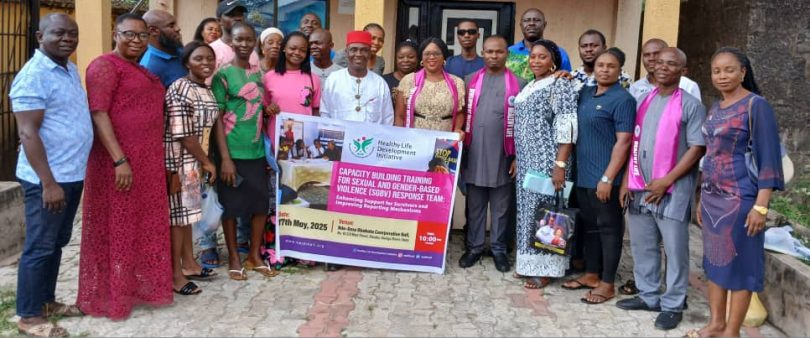
A non-governmental organization (NGO) that has been waging war against SGBV, Healthy Life Development Initiatives (HELDi), says it has successfully organized a one-day capacity building training programme for the Sexual and Gender-Based Violence (SGBV) response team in ONELGA.
The training is said to have been held at the Nde-Oma Cooperative Hall, 10 Mazi Street, Omoku, ONELGA, Rivers State. The theme was; “Enhancing Support for Survivors and Improving Reporting Mechanisms.”
According to report filed in by the Programme Coordinator, Dr Mfon Utin, the workshop is aimed at strengthening the capacity of team members to effectively respond to SGBV cases, enhance survivor support, improve data collection and reporting processes, and promote proper documentation practices.
The session featured expert presentations led by the HELDi Coordinator, interactive group discussions, and a robust question-and-answer session tailored to address key concerns specific to the ONELGA environment.
The programme began with welcome remarks from the Eze, Dr. Anthony C. Oganuzor, who emphasized the critical importance of collective efforts in supporting survivors of SGBV and the need to improve the mechanisms for reporting and response, holding perpetrators accountable, and addressing the root causes of violence in the community.
In her opening address, Dr. Utin, who clearly outlined the objectives of the training, stressed the urgency of building strong support systems for survivors and establishing effective, accessible, and confidential reporting mechanisms.
Dr. Utin commended the unwavering commitment of the participants in confronting the challenges of SGBV in their communities.
She presented a practical guide on the standardized reporting template, providing clear instructions on documentation procedures to ensure consistency and accuracy in reporting.
In her final remarks, Dr. Utin extended heartfelt gratitude to all participants, the facilitators, and the HELDi team for their dedication and active participation. She encouraged response team members to continue creating awareness in their various communities, emphasizing the importance of professionalism, confidentiality, timely response, and the establishment of a robust whistle-blowing mechanism to ensure safe and effective reporting.
She reassured the team of HELDi’s ongoing support and advocacy towards the official launch of the project by the state government, including the provision of identification cards to response team members after the launch. She emphasized that consistent, impactful work would attract the necessary support and ensure the long-term sustainability of the initiative.
Dr. Utin reiterated HELDi’s unwavering commitment to supporting the SGBV response team in ONELGA. She urged all team members to carry out their duties with courage, integrity, and dedication, noting that their collective efforts would lead to greater impact, increased visibility, and enhanced resource mobilization to sustain their vital work.
She said: “This training programme successfully equipped the ONELGA SGBV Response Team with the knowledge, skills, and motivation needed to offer coordinated and effective support to survivors while improving the systems for reporting and documentation within the community.”
Participants were given the opportunity to share their expectations for the training. A detailed presentation on SGBV, referral services, and the relevant legal frameworks, particularly the Violence Against Persons Prohibition (VAPP) Law, was delivered by Mr. TomBari Dumka Kote, the Coordinator of the Rivers State SGBV Response Team.
Mr. Kote further elaborated on Standard Operating Procedures (SOPs), reporting mechanisms, and the importance of meticulous documentation, outlining step-by-step processes to properly document and report SGBV cases while ensuring adequate follow-up and survivor support.
This highly interactive session fostered a deeper understanding of the legal, procedural, and ethical dimensions of SGBV response.
Participants engaged in two breakout group discussion sessions presented by lbegwuru Precious and Ojoba Christian focused on how to manage SGBV reporting cases involving both minors and adults.
These sessions, moderated by Mr. Tombari Dumka Kote, allowed participants to apply their learning to realistic scenarios. Their presentations demonstrated a clear understanding of their responsibilities and showed that they were well-equipped to carry out their duties effectively.
The training concluded with an engaging session in which participants raised key concerns, including the need for identification and motivation for response team members and strategies for addressing sensitive issues that arise from cultural beliefs that may hinder interventions.
Concerns were raised about the risks involved in intervening in cases of domestic violence, particularly fears of retaliation tied to traditional beliefs such as curses or the invocation of ‘juju’. often referred to locally as “Transformer.” Mr. Kote responded by affirming that the Constitution of the Federal Republic of Nigeria supersedes all local traditions and belief systems, and that the legal protection of SGBV responders is guaranteed.
Participants expressed appreciation for the training, affirming their renewed commitment to their roles. They noted that the sessions had enhanced their knowledge, boosted their confidence, and equipped them with the tools necessary to provide effective support and advocacy for survivors. There was strong enthusiasm for continued sensitization efforts, ongoing support, and more opportunities for learning and capacity building.