
- At gathering of Igbos begin in Okpanam, Nzeogwu’s hometown
By Jeremy Godson, Asaba
Professor Emeritus, Timothy Uzodinma Nwala, has given tips on how Ndigbo can survive what looks like living in bondage in Nigeria. Many Igbo sections and sub-ethnic groups especially from states outside the south-east now claim not being Igbo, despite speaking same language and sharing same cultures and tradition.
Details:
The future of the Igbos may depend on how much they succeed in evolving a strong political synergy among the various patriotic forces in Alaigbo.
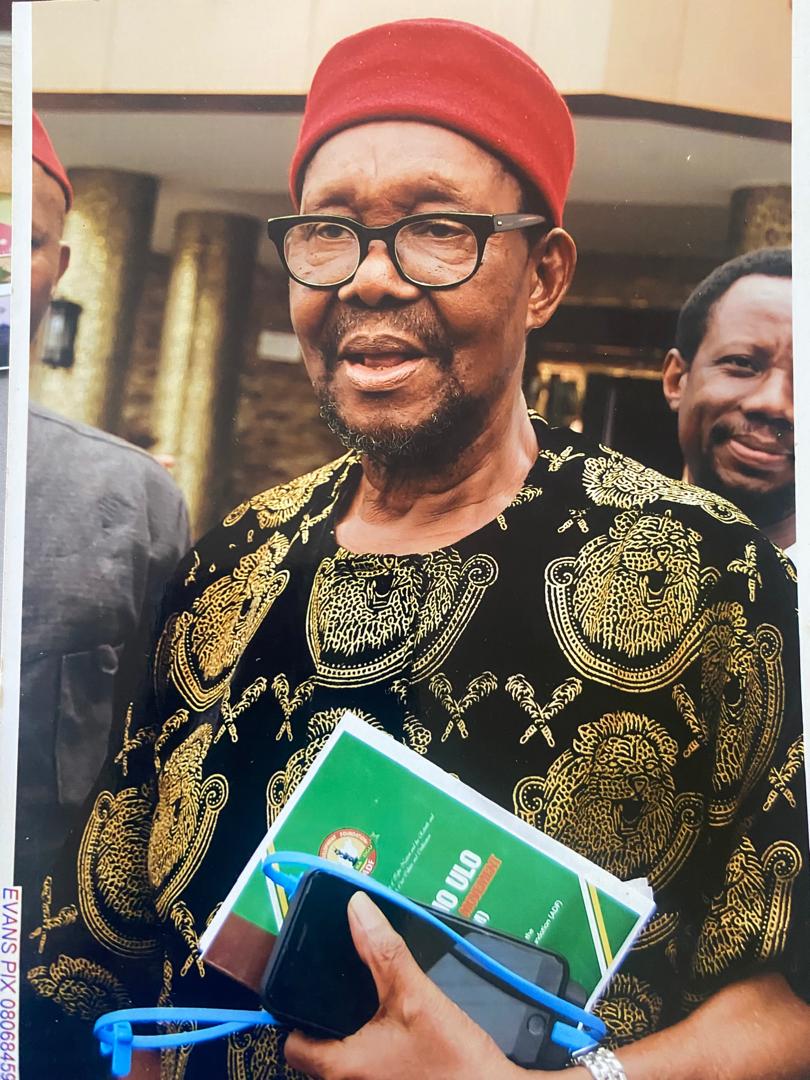
Emeritus Professor, Timothy Uzodinma Nwala, in his keynote speech at the National Conference of ‘Igbo Bu Out’ which held at Okpanam in Delta State, gave tips. Okpanam is the hometown of the late Lt Col Patrick Chukwuma ‘Kaduna’ Nzeogwu who died in July 1967 during the Nigerian civil war time.
Prof Nwala said evolving such a strong political synergy would require the support of the political class and leadership, the business class, the youth and the women.
The Emeritus professor and researcher who has delivered many telling papers on the Igbos said: “What is more we need the critical role of the committed educated class – the intelligentsia, who possess the necessary exposure, training and capacity to monitor developments in the society and the world, collect and collate the relevant data, do the necessary analysis and draw up the appropriate conclusions.
“On the basis of these, they would formulate the guiding policies and modalities for their implementation to meet the political and economic challenges faced by the Igbo Nation.”
In his conclusion of the bulky paper, the researcher submitted that the Igbo nation was once acknowledged to be one of the 10 great and dominant nations of the world; the genius, industry, courage and drive of her citizens recognized and respected all over the world; a people highly adaptable and self-reliant, a nation of warriors, humble but shrewd and aggressive commercial class, highly devoted clerical class.
He said they are accepted all over the world as an inventive people with literati whose creativity and intellectual accomplishments continue to dazzle the world; a nation that gave the world Azikiwe for world politics, Achebe for literature, Emeagwali, Chike Obi and Animalu for Science, Uzodinma Nwala for Philosophy. “The nation still commands within her ranks men and women who can collectively pull her and her citizens out of the present historical predicament.”
The foundation of all this, he said, is of course the fostering of collective solidarity and unity of purpose; a role that only Ohanaeze Ndigbo can effectively play. “Unfortunately, Ohanaeze has been the major target of those who wish to disorganize Ndigbo, through their internal agents and self-serving agents within Alaigbo, the enemy has taken control of the nerve-centre of Igbo leadership and resistance. They have thus rendered Ohanaeze Ndigbo moribund.
“The solution to this challenge lies in the sustenance of major pan-Igbo intellectual and social organizations; The Alaigbo Development Foundation has played this role very ably and strategically, ADF has stoutly defended Igbo intellectual, military and political leaders who have been the target of the enemies of Ndigbo. These include General Azubuike Ihejirika, Group Captain Emmanuel Ihenacho, Prof Barth Nnaji, Mr Peter Obi, Chief Innocent Chukwuma, etc/”.
He said Igbo marginalization is a realty but wondered if the elephant can be marginalized in the bush, and referred to the statement by the late Dr Basil Nnanna Ukaegbu. “On the issue of Igbo Marginalization in power equation in Nigeria, Dr Ukaegbu once said that the case of Igbo marginalization in Nigeria is like the case of an elephant being marginalized in the bush. According to him, an elephant cannot be marginalized in the bush.
“There is so much truth in those words of irrepressible Basil Nnanna Ukaegbu, however, the elephant becomes marginalized in the bush, the mighty falls, or Goliath is vanquished by a David purely on the basis of superior tactics and strategies.
“The political weakness of the Igbos which is the reason for the denials and violations of their individual and collective rights within the Nigerian Federation derives largely from their failure to appreciate the nature of politics in a multi-ethnic society, and consequently from lack of appropriate tactics and strategies for survival in a hostile multi-ethnic federation.”
Simply put, the elephant must embrace superior tactics to avoid being marginalized in the bush just as lack of tactics led to the death of Goliath.
Thus, he said Nigeria is a federal state of over 250 nations whose cultural identities remain deeply engrained in the psyche of the citizens of each nation. Political struggles, as political scientists and philosophers have emphasized, are not just struggles for power among individuals, but among contending social forces. “In a multi-ethnic society, the most organic and dominant social forces are the socio-culturally and historically situated ethnic nationalities. Therefore, politics in Nigeria is first and foremost largely struggles among nations. Only those who fail to realize this fact remain irrelevant in the scheme of Nigerian Politics, with its attendant political implications for her citizens.”
Tracing the origin of Ndigbo that is expected to pull the Igbo out of the doldrums, Prof Nwala told the ‘Gathering of Ndigbo’ that it began after the war: “Ndigbo emerged from the war greatly devastated psychologically, socially, politically and economically. Unfortunately, they had no central voice to organize and speak for them.
“To fill the vacuum, Ohanaeze Ndigbo was founded in 1976 as an umbrella organization to speak for Ndigbo worldwide. The first meeting of the new pan-Igbo organization was held at the Enugu residence of the venerable Dr Akanu Ibiam who became its first Chairman, with some notable others as Dr. M.I. Okpara, Chief Dennis Osadebe, Dr. K.O. Mbadiwe, Chief M.I. Ugochukwu, Dr. Pius Okigbo, Chief Jerome Udoji (the first Secretary-General), Prof. Ben O. Nwabueze, etc.
“The main concerns of Ohanaeze have been the marginalization of the Igbo people in Nigerian politics, more positive integration of Ndigbo in Nigeria, a more equitable political structure and system in the federal system, the neglect of indigenous Igbo territory in social amenities and development of infrastructure, the incessant harassment of Igbo citizens in other parts of Nigeria, etc.”
The Ohanaeze constitution however demands a ‘non-partisan, non-sectarian pan-Igbo Cultural Organization designed to provide a platform where Ndigbo, within and outside Nigeria, may come together for the purpose of nurturing better understanding and harmonious relations amongst themselves, with other ethnic groups in Nigeria, and with all communities wherever they reside.”
The present Ohanaeze constitution, he stated, provides for a grassroots formation with the LGA Ohanaeze comprising all the Town Unions or Autonomous Community Associations in a Local Government Area. It also grants membership to approved organization of Ndigbo in the Igbo Diaspora.
The keynote address traced the golden age of Ndigbo around the world and mentioned accounts to show that there is evidence of an Igbo shrine in Ile-Ife.
He however showed how prominent Igbos were massacred in Asaba and some other towns, thus striking fears to Igbos in the Delta areas to this day. He however concluded that Igbos from the non-South East states were all Ndigbo who he said played very prominent roles for Ifbo preservation either in the war front or political, business, diplomatc, or academic fronts, despite fears of marginalization.
$$