
By Jeremy Godson
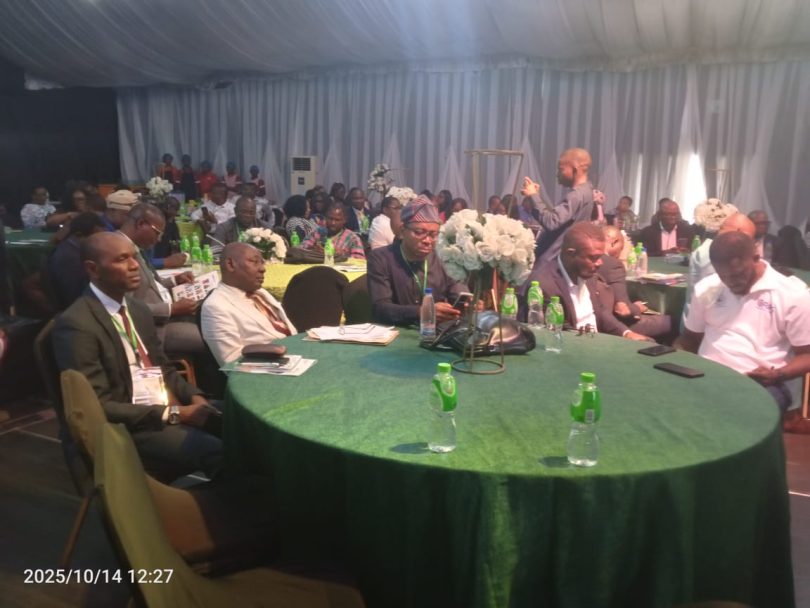
The Chartered Institute of Taxation of Nigeria (CITN) the second week of October 2015 into a ‘Tax Week’ and mounted what is regarded as the first Port Harcourt Tax Conference in the Garden City.
The major takeaway was the message of hope whereby individuals and states were encouraged to fear less over the new tax regime. The 17th national president of CITN, Mr Innocent Chinyere Ohagwa (FCTI), who allayed the fears, urged Nigerians not to keep fretting over the tax reforms initiated by the President Bola Tinubu administration.

Details:
The reforms have led to the enactment of the Nigeria Tax Act (NTA) and others.
Now, the reforms have been described as a bold initiative towards freeing sub-nationals from overdependence on federal allocations.
This comes against the backdrop of an over 70% dependence on oil revenue distributed through monthly federal allocations by many states in the country.
He did this while delivering a speech at the Tax Conference held in the Garden city on October 14, 2025, where he said the new tax laws have created opportunity for states to drastically review their tax collection efforts and boost internally generated revenue (IGR).
He urged states in the federation to take advantage of the opportunities captured in the new tax laws by reviewing their tax collection processes and design, and deploying technology to automate the process.
Ohagwa said sub-nationals should rather focus on creating enabling environment for willing compliance to tax payment among the citizenry.
“The focus is not on paying tax. The focus of the reform will be to enhance the standard of living of the masses, the citizens, and secondly, to ensure that the tax compliance system is made easy.
“And when you make tax compliance easy, the fallback position is that you will collect more, you will incur less costs, the country will develop better,” he said.
Mr Ohagwa disagreed with the suggestion that the tax reforms have placed some states with less population demographics at a disadvantage, arguing that those with high net-worth individuals, such as Lagos and Rivers, are strategically positioned to reap the benefits of the tax laws.
He said, “Another area of advantage to the states is what we call presumptive regime, which the minister through the advice of the Joint Task Force is going to make available. States are going to leverage a lot on it.”
He said the benefits of the new tax laws for citizens will begin to manifest as the government begins administration of the reforms, urging individuals, tax authorities, and consultants to take advantage of the opportunities inherent.
Victoria Okokon, Chairman, CITN’s Port Harcourt & District Society, said the tax reforms offer challenges and opportunities for sub-nationals.
She however pointed out that the reforms were not designed to weaken revenue generation at the sub-national level, but to strengthen the ability of states to generate and boost their revenue.
Sir Israel Onwuanaku Egbunefu, Fellow of the Chartered Taxation Institute (FCTI) and Chairman of the Rivers State Internal Revenue Service (RIRS), presenting a paper on ‘Expanding the Tax Net Beyond Salaries: Wealth, Informal Economy, and Sub-National Revenue,’ said 70% percent of the tax receipts in Rivers State is from Pay As You Earn (PAYE).
On the crux of the matter, he quoted a 2020 World Bank Report thus: “The crux of the matter and the core problem facing Rivers State is a narrow tax base that primarily relies on formal sector salaries (PAYE). This dependence excludes the Real Estate Sector, informal taxes, digital economy taxes, marine & other blue economy taxes, creative economy & tourism and property owners and wealthier households that could contribute significantly to the tax system. Such exclusion creates inequity, revenue volatility and fiscal vulnerability (World Bank, 2020).”
He said the need to wean the state of the over dependence on this source, and to diversify to other revenue sources, such as Blue and Digital economy, is both urgent and imperative.
Chris Yorkina, Rivers State Auditor General, pointed out that the design of the new tax laws is not to impoverish the poor, but to aid government drive for development.
He said tax officers should be abreast of the provisions of the new tax laws and be ready to guide citizens, who naturally lack knowledge, on them.
Yorkina pointed out that the new tax law repeals certain existing tax laws and creates a legal framework to strengthen simplicity, integrity, and efficiency in tax administration
Ignatius Chukwu, BusinessDay’s Regional Editor, said the informal sector in the state has been overtaxed, with traders and artisans paying for over 70 items on an “black market” tax list.
He pointed out that low income earners, such as artisans, who are exempt from PAYE, have been pushed into what he described as the “black market tax system,” which is operated by non-state actors, and maintains a high tax incidence on the already overtaxed informal sector.
Chukwu urged the Rivers State government to enforce the autonomy granted the state internal revenue service (RIRS) by the law establishing it, arguing that this will allow the agency devise and implement initiatives that will boost the tax net and collection efforts.
Prof Ezekiel Eden Williams, Director of Eggheads International, presented a paper on ‘Subnational Expectations and Implementation of the New Tax Laws.’
He deposed that Nigeria’s 2025 Tax Reform represents the most comprehensive fiscal legislation since independence, fundamentally restructuring the nation’s revenue architecture. “For subnational governments—particularly States and Local Government Areas (LGAs)—the reforms introduce both unprecedented opportunities and existential challenges.”
His paper sought to examine the institutional, operational, and strategic imperatives facing Rivers State and similar jurisdictions as they navigate the transition from fragmented tax administration to a unified, technology-driven fiscal framework.
Drawing on comparative federal systems and grounded in the statutory provisions of the Nigeria Tax Act 2025, Nigeria Tax Administration Act 2025, Joint Revenue Board Act 2025, and Nigeria Revenue Service (Establishment) Act 2025, his paper provided a roadmap for compliance, capacity building, and competitive positioning in the post-reform era.
He used keywords such as fiscal federalism, subnational taxation, tax reform implementation, institutional capacity, State Boards of Internal Revenue (SBIR), restructuring, and others to put the concept to bed for easy understanding.
Chris Yorkina explored the New Tax Laws, as they relate to tax practitioners.
The first-ever Port Harcourt Tax Conference attracted important experts and authorities in the tax space and witnessed exciting moments and fireworks. It ended with commitments to tax training and enlightenment campaigns to get more people and the media into higher attention.
$$