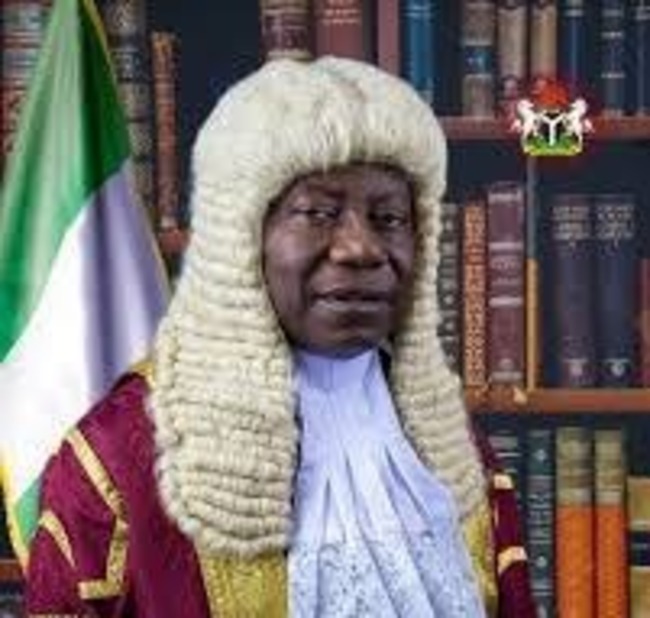

Good afternoon and thank you for being here. This day marks the end of a long and reliable journey on the bench, well-established by the grace of God, and also established through the presence of all of you.
Let me say a few words as I exit the bench. I was born in Lagos on the 17th of February 1956, at the Massey Street Children’s Hospital in Lagos. The time of my birth, as some have pointed out, coincided with the visit of Elizabeth II, Queen of England, to Nigeria. And so, I was nicknamed “the Queen’s birthday” by both of my parents. My father, Mr. Bob-Oma Adejumo, was the second son of the paramount Chief O.G. Adejumo. His father sent him to St. Edwards Catholic College in Freetown, Sierra Leone, around the year 1923 for his secondary school education. Nigeria was still very much a British colony at the time.
My father was a senior civil servant during the colonial period; he retired from the central technical department as an accountant a few years after my birth. My mother is Mrs. Eniola Adejumo. She is still alive. She is 97 years old. I was the first and only son. I have two incredible sisters, Biola and Dele—the best sisters anyone could wish for.
I started my primary school education at Mayfield Junior School in Abeokuta, a private boarding primary school in the then Western Region of Nigeria. Its location is in the present-day Ogun State. Just before the Nigerian Civil War, I left Mayfield Junior School and was enrolled in Corona School, Ikoyi, Lagos, another private primary school where I remain today as an alumni of primary school in Lagos. And that is where I met my friend of over 60 years, the former Vice President of the Federal Republic of Nigeria, Professor Yemi Osinbajo. Our lives have been intertwined ever since. I had my secondary school education at the most noble and prestigious King’s College, Lagos, where I obtained my West African School Certificate in Division 1. I went on, still at King’s College, Lagos, to do my High School and there obtained a High School Certificate that gave me direct entry to the University of Lagos, where I obtained my LLB degree. I later went on to the Nigerian Law School, Victoria Island, Lagos. I attended the Nigerian Institute of Advanced Legal Studies; there I received the academic prize for the best student in the second legislative drafting programME for justice administration.
I went on to the London School of Advanced Legal Studies at the University of London, Russell Square, London, under the sponsorship of the British Council. Later, I enrolled at the University of Birmingham in Birmingham, England, where I obtained my LLM degree.
Today as I sit here, I remember my best friend, Mr. Bob-Oma Adejumo of Lagos. Daddy, I remember you today and always in my heart, and in the hearts of all those who knew you. Looking at life at 70, I cannot but agree with Shakespeare, where he wrote in his book, As You Like It: ‘All the world’s a stage, and all the men and women merely players. They have their exits and their entrances.’ I have spent almost 31 years in that act of sitting on the bench on the stage of life. I have gone through several scenes: the scene where I was sworn in as a High Court Judge in Rivers State; the scene where I performed my role as a High Court Judge; the scene where I was elevated and sworn in as a Justice of the Court of Appeal; the scenes where I worked in Ibadan, Kaduna, Lagos, Akure, and Asaba divisions of the Court of Appeal; and the present scene where I bow out.
Today I thank God for seeing me through all the acts and scenes of the judiciary stage. I have written about 1,500 judgments, traversed Nigeria North, South, East, and West by road and by air for a number of kilometers I cannot put into figures.
As another act opens and a new scene unfolds on the stage of life, I hold onto Him who holds the ends of the beginning. I believe the words of my favorite hymn: ‘Guide me, O Thou great Jehovah, I am weak but Thou art mighty, hold me with Thy powerful hand.’
I know that God will continue to guide me through fresh acts and scenes on the stage of life as they unfold. But as the scene of this act draws to a close, it is necessary for me to mention two jurists of distinction: First, Honorable Justice Kayode Eso, who is now late, former Justice of the Supreme Court. At one point, this Honorable Justice Kayode Eso invited me to his house, then at Force Avenue, Port Harcourt. He placed a bottle of wine on the centre table in the sitting room and told me he was going to recommend me to the bench. I was surprised; I did not see it coming. In his avuncular manner, he said he was happy to recommend me as he was convinced that I would be a good judge. That was all. No application letter, nothing. Thank you, Honorable Justice Kayode Eso. May your rich and noble soul continue to rest in the bosom of the Lord.
I often wondered why the bench was seen as a scene. I was 39 years old at the time, and to see a lawyer from my hometown and indeed my village, being made a High Court Judge in Rivers State—it didn’t seem possible that I would be one.
The second jurist of distinction I must mention is my unforgettable teacher and noble former President of the Court of Appeal, Honorable Justice Monica Dongban-Mensem, CFR. My Lord, the President of the Court of Appeal remains my unforgettable teacher. She was the first Presiding Justice when I was elevated to the Court of Appeal and posted to the Ibadan Division of the court. I arrived in Ibadan in a mood that was anything but happy. Barely a week after my arrival, I got a formal letter from the Rivers State Judiciary giving me notice to quit my official residence in Port Harcourt within three months of the notice. I had no residence in Ibadan where I could presently move my family into. When I received my first pay at the Court of Appeal, I could not believe my eyes. The figure I saw was roughly half of what I was receiving as a judge in the Rivers State High Court. My knowledge of geography is that the higher you climb, the cooler it becomes. But there was nothing cool about my elevation to the Court of Appeal. Rather, it appeared like being sent to the Gulag Archipelago, like Aleksandr Solzhenitsyn.
Yet it was at that low moment of my career that Honorable Justice Dongban-Mensem, who had recently lost her first son after a promising law student in a ghastly motor accident, stepped in to show empathy and compassion. Despite her own loss, My Lord, my unforgettable teacher, she had a belief in her heart that I was not totally discouraged, disheartened, or distraught. I have lately read about the Catholic saint, Saint Monica. She lived between 332 and 387 AD and is also regarded as the mother of virtues. I saw in My Lord, Honorable Justice Monica Dongban-Mensem, a twin of Saint Monica.
Permit me to recall a specific incident or instance in Ibadan. I don’t know how My Lord learned about my financial difficulties. My Lord had just received her annual medical allowance. She called me to her office and gave me the entire allowance, adding that I should refund it whenever I am able to do so. My Lord, the Honorable President of the Court of Appeal, what can I say? You are my sister from another mother. Thank you.
JUDICIARY
Give the judiciary some credit:
I am also bound to say a thing or two about the judiciary. Many legal minds have often said that the judiciary is the last hope of the common man. I believe this statement is true. However, lately in Nigeria, the problem of vitriolic attacks directed at the judiciary has become very loud and disconcerting.
In the midst of the din, the judiciary has been denied one of the two top pillars of natural justice: audi alteram partem, the right to a fair hearing. I think it is necessary to give the judiciary some credit. Of the three arms of government, it is only the judiciary that has the mechanism for internal discipline. In this regard, the National Judicial Council has exercised disciplinary action against many erring judicial officers, including in some cases outright removal from office. It is also noteworthy that in the judiciary, the work does not stop at the trial court. It is evident that when the decisions of the trial court are wrong, the appeal process through hierarchical courts leaves room for correction. The unnecessary vilification of the judiciary must therefore be reigned in, as there are means for ensuring that even when decisions are perceived to be bad, they can be corrected on appeal.
While I will not say that there is no loss that ails the judiciary, the naturally enamored negativity—to borrow the phrase used by the current Vice President of the United States, Kamala Harris—must not be given fresh free rein. This is because if the judiciary is destroyed, we might as well say goodbye to the rule of law, as the law of the jungle will prevail—meaning that it is those who are strong and apply ruthless self-interest who will be successful. It is also necessary to say that it is incumbent on every judge to live up to his oath of office, namely, to do justice without fear or favor, affection or ill will. No judicial officer should for any reason refuse to mirror the image of Lady Justice, originally known as Themis, the Greek goddess of justice. Lady Justice has been portrayed as having blindfolds, meaning she does not care to know who is before her. She holds the scales of justice, meaning she carefully weighs every side of a case presented to her to see where the evidence preponderates. And she holds the sword, meaning she strikes only in favor of justice and the truth, having disregarded who is before her and regarded only the evidence before her. Judicial officers must hold dear the legal maxim lex non novit patrem, nec matrem, solam veritatem, meaning ‘The law knows neither father nor mother, but only the truth.’
THE JUDGE MUST BE JUDGED
Every judge must also remember that the judge too will be judged, as the Bible says in Matthew Chapter 7, verses 1 and 2.
Working as a judicial officer has afforded me the opportunity to live and work in all parts of Nigeria: West, North, East, and South, in that order. It is necessary to appreciate what we have. As the proverb goes, ‘You don’t value what you have until you lose it.’ The rat race in Nigeria has got to stop, whether in politics, in careers, or in business. But why must a thing be a do-or-die matter? Why must the sentiment be ‘it is either my way or the highway’? Why must there be a reckless race to acquire and acquire without regard for the common good? While I read that wealthy people in Western countries plan to give away 99% of their wealth, here in Nigeria, there seems to be no thought of the future, apparently.
This attitude of Nigerians is causing the country a lot of harm. We as Nigerians must look at ourselves in the mirror, and perhaps we will see the reflection of where the problem truly lies. We must be emphasized beyond parochial and homegrown sentiments. Indeed, we must embrace and lay emphasis on the high-minded sentiment eloquently captured in our national anthem, which exhorts: ‘Help us to build a nation where no man is oppressed.’ That way, Nigeria will be blessed with peace and plenty. We must live and let live; the sky is big enough for everyone.
As I conclude this speech, I thank My Lord, the President of the Court of Appeal, Honorable Justice Monica Dongban-Mensem, CFR, JP, for making this valedictory session a memorable one. It is a great honor to have her presiding during this special sitting of the Court of Appeal. I thank His Excellency, my friend, the former Vice President of the Federal Republic of Nigeria, Professor Yemi Osinbajo, GCON, for being present today. It took me by surprise. I thank His Excellency, the Governor of Rivers State, Sir Siminalayi Fubara, ably represented by the Deputy Governor of Rivers State, Professor Ngozi Odu, for the magnanimity towards making this occasion successful. It is a testimony to the high regard that Her Excellency and His Excellency have for the judiciary that their presence is represented today.
I thank the Presiding Justice of the Port Harcourt Division of the Court of Appeal, Honorable Justice O.B. Williams. Your leadership has been exceptional. I thank my brothers, Presiding Justices and Justices from various divisions of the Court of Appeal for being present here today. I am happy that many of you are not only brothers but are also friends. I will miss you all.
I must specifically thank my brother, Justice of the Asaba Division, it has been a great pleasure working with you. I thank the Chief Judge of Rivers State, Honorable Justice Simeon Amadi, who is a brilliant jurist, gentleman, and brother, as well as the judges of the High Court and courts of record of Rivers State, not forgetting members of the magistracy of Rivers State.
I also take the opportunity to thank the Chief Judge of Bayelsa State for being here. Thank you very much for coming. I thank the Justices of the Federal High Court in the Federal Capital Territory, the High Court, and the National Industrial Court of Nigeria. I thank my brothers who have retired and who are here to honor me on this day. Thank you very much for coming to honor me today. I now join your ranks. I thank the former Attorney General of Rivers State and the Attorney General of Delta State, Senior advocates of Nigeria, you are noble men. I thank the Senior Advocates of Nigeria, members of the Body of Benchers, and all legal practitioners for the great honor of being present here today. I thank the planning committee led by the former Honorable Attorney General and Commissioner for Justice of Rivers State, and the team of eminent personality. I give my respect to you all.
I thank all the staff of the judiciary who worked directly with me: my marshals, orderlies, secretaries, and clerks over the years. Some of you have come from many divisions to honor me today. I know that four of you came from far. I thank you all. I had the pleasure of working with many BCRs (Bench Clerk Registrars) in various divisions of the Court of Appeal. Some of you are here today to wish me well. Thank you. I specifically thank the amiable and indefatigable Chief Registrar of the Court of Appeal. Let me also thank all those that I have specially invited who have shown up today.
$$