
And major gains of the 3-day economic and investment summit in Port Harcourt
By Ignatius Chukwu
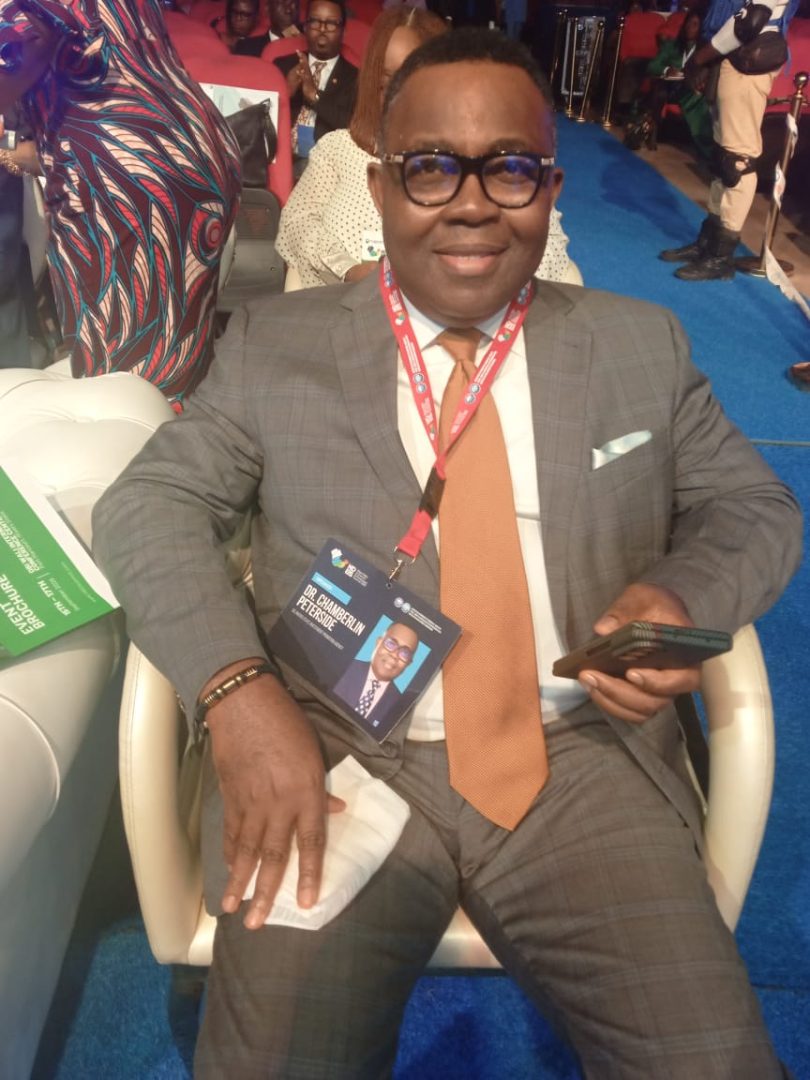
All is set for the emergence of an economic think-tank in the Niger Delta. Dr Chamberlain Peterside calls it a task team or crash team. It is to bring together all the plans and suggestions from the many development and interventionist agencies in the oil region and create a single pathway.
Details:
An economic think-tank may soon emerge in the Niger Delta region to coordinate the many suggestions in several files from the many development agencies in the region.
This is as suggested by Dr Chamberlain Peterside, a development and financial expert at the sidelines of the just -concluded Niger Delta Economic and Investment Summit. This line of thought has also been adopted by the Niger Delta Chamber of Commerce, Industry, Trade, Mines and Agriculture (NDCCITMA).
The development agencies putting forward proposals include the Niger Delta Development Commission (NDDC), the South-South Development Commission (SSDC), the BRACED Commission comprising Bayelsa, Rivers, Akwa Ibom, Cross River, Edo, and Delta states. There is also now the NDCCITMA, each having organized economic summits and roundtables with exciting proposals.
In an interview with IGNATIUS CHUKWU on the sidelines, Dr Peterside put up a proposition, asking the various development agencies to set up a think-tank to harmoise the proposals and come up with action plans that would have who should do what, and where the funds should come from.
He said: “They should work together by setting up a task force—a task team of high-level thinkers to come up with a strategy. Because it’s about coordination and collaboration. The entities are all regional entities.
“So, there has to be a way for them to come together, work together, and set up a crash team to set up a Think Tank. It might be ad hoc, because you can’t be setting up permanent structures upon structures. You already have the BRACED Commission, you have NDDC, you have South-South Development Commission, now we have the Niger Delta Chamber of Commerce.
“So, we have enough of these entities in existence, but the question is: how are they working together? What are the practical steps? What are the projects? And what actionable ideas can we take away from this economic and investment summit? That’s the key focus of my panel.”
Speaking at the end of summit, Mr Idaere Gogo-Ogan, chairman of the NDCCITMA, said the think-tank is now the way to go. He said the NDDC had demanded for a think-tank as outcome of the summit.
The oil/gas expert said they had the mandate to make the summit successful both in quality and mobilization of the people of the region. He said their mandate was to integrate and mobilize and get an economic think tank.
“I’ll be praying to God every day that every name that will be in that economic think tank will be people that will work for the Niger Delta.
“If you are not ready to put on your intellect and work hard don’t even bother to call me to include you in the economic think tank because this will be the engine room to drive private sector-led development that will usher in unprecedented economic development and shared-economic prosperity in our region.”
He said there was no longer problem of insecurity in the region and so, elites must be ready to come home and help.
He went on: “I will make this promise; next year with the Niger Delta economic and investment summit group we are going to showcase the potentials of the Niger Delta region in London. It is the capital of investment funds. We are going to call Ernest & Young or Pricewaterhouse and pay them. We will not wait for NDDC but we will call on three or four people and we pay these advisors to draw out a business plan of the economic potentials of the Niger Delta.
“For every state, they will be able to tell us what they are most competitive in. There will be no speculation when talking of investment. When we take Batelsa or Akwa Ibom to London, we know what we will tell investors to invest in. And when you do that due diligence, and do their business plan, what we recommend and what they see by way of finding will be same. It’s going to be a tough job, but we believe we can do it.”
Peterside gives takeaways:
Listing some takeaways of the summit, Peterside, who is the General Manager of the Rivers State Investment Promotion Agency (RSIPA) and onetime finance commissioner in Rivers State is that the region’s elites and planners must do more.
Dr Peterside is the Chairman/CEO at Xcellon Capital Advisors Limited. He comes with a diverse background spanning over 23 years in the global business arena, covering investment advisory, wealth management and public finance, being a well-rooted financial expert and strategist.
Speaking further, he said: “But beyond the talking, we have to come up with actionable ideas, practical steps, especially on a regional basis.
“The beauty of this is that you have the Niger Delta Chamber of Commerce, and I’m sure you are aware of the BRACED Commission is largely very active. Two weeks ago, they met the governors of the South-South, and they came up with a communique of things they should do. And one of their most important decisions is to take on one thing, the possibility of taking on one regional project such as a railway transportation project, or anything of that nature; whether it’s a regional trade development, or whether it’s a regional industrial hub.
“So, I think that in a session like this, we spoke about whether we should focus on fisheries and aquaculture, but most importantly, how do we develop the human capital? How do we enhance inter-regional and intra-regional trade?”
He went on, “And of course, we have our brother from Western Cameroon, which is as good as being a part of the Niger Delta. So, I think with this kind of session and the panel, it is possible that we can generate ideas, energize activities, and make things possible.
He said he was happy that some of the resource persons spoke strongly about states of the region going to the capital market to source funds for critical developments.
Key session anchored by Dr Peterside:
The three-day summit had many sessions, the first on day-two being ‘Regional Trade Integration & Infrastructure competitiveness’ which was anchored by Dr Chamberlain Peterside.
The lead paper was by Dr Emomotimi Agama, Director-General, Securities & Exchange Commission (SEC) who took the elite audience through ‘Financing Infrastructure, Marine and Blue Economy of the Niger Delta through the Capital Market: A Pragmatic Approach to the Development of Rivers State.’
The second speaker was Timi Alaibe, ex-Managing Director of the NDDC, who took on ‘Regional Trade Integration & Infrastructure Competitiveness: Unlocking the Niger Delta’s Economic Potential’; while the third speaker was Dr Ebinimi Ansa (Fishery expert), who spoke on :’From Local Waters to Global Markets: Unlocking Fisheries Potential Through Infrastructure Competitiveness.’
The fourth speaker was a Cameronian, Mr Napoleon Besong Nyake, Chairman, National Cocoa and Coffee Board of Cameron who spoke on ‘Balancing Regional Trade Through Cross Border Partnerships’; the fifth speaker was Dr Dere Awosika, Public Sector Governance expert and retired permanent secretary in three Federal Ministries. She spoke on ‘Industrial Parks in the Niger Delta’; while the sixth speaker was Dr Zuwairat Asekome; Assistant Manager, Strategic Plans and PMO at Nigerian Content Development and Monitoring, who spoke on ‘Industrial Cluster Development in the Nige Delta’.
Opening the day, Dr Peterside described the speakers as principals who carry huge influence and capacities in various sectors of life, and who command attention anywhere they speak in the world. He admitted that the Niger Delta Economic and Investment Summit had been in the pipeline for a while, and that as the DG of the Rivers State Investment Promotion Agency, they had been working very closely with the Niger Delta Investment Summit organizers.
“I’m glad to say that finally, the event is coming through. The last presentation by my friend, Agama, the DG of SEC, was very, very clear. He spoke about capital raising. He spoke about how Niger Delta states, and especially Rivers State, can raise capital for infrastructure, how it can tap the bond market.
“And these are some of the ideas that we’ve been pursuing here in Rivers State. In my previous life as the Finance Commissioner, we tried to raise bonds. We know that it is accessible, and it’s possible. Unfortunately, it didn’t happen. And the reason is because we thought that our willingness, political and others were enough to make it happen. It didn’t. Now, listening to the address today, you will see one common thread: Rivers State, and indeed the Niger Delta, is endowed.
“We are endowed with resources, but in terms of execution, we are still way behind. We’ve been unable to leverage our fat allocations, leverage our resources to grow our internally generated revenue, unable to tap the bond market to build infrastructure.
“We are not short of ideas, but unfortunately, we haven’t been able to execute. So, I think that in that light, this inaugural investment summit is designed to begin to make so much loud statement, but to chart a course. What are the practical projects? What are the practical steps that Niger Delta states and, indeed, NDDC can help to foster? How do we go about this? In our panel today, we will be talking about regional integration, we’ll be talking about developing the resources, the natural resources, how we can grow the human capital, and how we can build industrial parks?
“Please, let’s focus on practical steps, projects, and actionable ideas, so that when we leave here, we’ll be able to say, this was achieved, and these are going to be the deliverables going forward.”
Dr Emomotimi Agama, DG SEC:
The Niger Delta deserves the attention of her sons and daughters, not waiting for outsiders to come develop it. The Capital Market is the parameter of any economic entity, and infrastructure can only come from long-term funds for sectors such as agric, roads, schools, etc. You can’t grow your economy without capital market money.
Rivers State is the most economically advanced state in the region, and thus, economic development of Rivers State will spread and rub off on the others in the region. States in the region seem uninterested in the capital market. Of the 2.2% of the Pensions Fund of N30.7trn, Lagos alone has collected over half of the fund in bonds.
Niger Delta states are missing in the Capital Market whereas the region needs over N301bn to meet up with infrastructure developments. The region must understand the value of the capital market. Stop relying on FAAC or IGR to carry out big ticket projects, its will never be enough. How many companies from the Niger Delta are listed in the stock exchange? This region may have lost the advantage or benefits of the Stock Exchange, but it is not bad to start.
The meaning of the Dangote IPO to the Niger Delta region is important. The company is created from the Niger Delta resources in the sense that it’s from the urine of the ancestors of the area. Oil/Gas is abundant; it can only be developed by capital market.
Blue economy belongs to the Niger Delta region; why are we waiting for somebody from outside to come and develop it for us? The Niger Delta must embrace the capital market. This is because, long-term funding is badly needed to develop assets in the region such as agric, roads, education, health, etc.
What is needed are legal framework, institutional investors, instruments for investment, and independent credit opinion (rating) for sake of promoting transparency. If these are done, in three years, blue bonds can emerge.
There is need for a private sector fund for Niger Delta development. Green economy is possible in places like Opobo, Bonny, etc, where the ocean has a high point. Niger Delta development is thus in our hands. The NDDC is a great idea but it alone cannot accomplish the Niger Delta development mandate but a private sector development fund is needed.
I urge the region to take bold steps to save or kill the region’s story.
Timi Alaibe: Ex-NDDC CEO:
The Niger Delta needs a new regional economy driven by production, trade, investment. I propose that the Niger Delta next digital move should be on production, not extraction.
Palm oil created Oil Rivers, but AfCFTA is an opportunity but not a guarantee. Cost of moving goods, logistics, etc is a hindrance.
The Niger Delta Paradox: Everything is available but they do not function well due to integration deficit. Economic corridors must emerge. The region must develop Economic Corridors and the need to build regional economic gateways connected to Abia (Ariaria), waterways, security network to protect the business corridors.
There is the need to replicate community-based security institutions such as Tantita and others. Their activities have reduced crime in the region. Niger Delta is indeed ready for investment, trade, tourism, and other activities.
Dr Ebinimi Ansa: Fisheries expert: From local markets to global markets.
There is need to create operating corridor. Fish farm clusters need to integrate. And between catching of fish and exporting fish needs, there is need for cold rooms; traceability, and certification. Diversification is needed, not just only catfish should be known and reared. Processing is important; and there is need for solar tents to preserve crayfish for export. There is need for fisheries infrastructure such as landing jetties, dryers, etc.
Mr Napoleon Besong Nyake:
Balancing trade with cross-border partnerships;
There is need to look across the border in the Niger Delta region. We know that about 80% of those in the blue economy (fishermen) in Cameron are from Nigeria’s Niger Delta region. There is cocoa and coffee production.
Cocoa from Cameron is smuggled into Nigeria and from there it is exported to Europe. It is of little value to the region because it is raw product that is exported which comes back as chocolate and other finish products.
Let us create value chains: Can Port Harcourt (Nigeria) and Duala (Cameron) form a trade gateway to the larger Africa? We need connectivity, not only hubs. The region has resources and human capital, but integration with connection is not there. The real place of border to an economy; from oil hub to trade gateway. What is needed is partnerships. So, expand the plan beyond the Niger Delta.
Trade agreements abound but they are lying in government files but do not lead to warehouses, etc. There are up to 10 advantages of cross-border partnerships; it transforms obstacles to advantages.
We call for creation of trade corridor. Industrial clusters can create a Port Harcourt-Duala Trade Corridor. We demand action: What role should governments play. A 5-point agenda should be created. There should be a Nigeria-Cameron Council. There should also be an annual Nigeria-Cameron Investment Forum.
Dr Dere Awosika: Need for industrial parks in the Niger Delta
There is need to focus on human capital development. Even if vessels are procured, there is need for indigenous manpower to man them. The economy of the oil region needs to be diversified.
Our past was I agriculture. Today, its in oil/gas. The future should be in non-oil production and processing. Resources do not lead to development. It is not all about capital, but about building institutions and human capital.
Weaknesses of the economy of the region include fragmentation (absence of cohesion); short term planning horizons of about two to four years; and weak accountability; poor human capital efforts would mean that even if projects are developed or vessels procured, the problem would be manpower to man them.
Industrial Parks: Government must do business at least take equity in projects. There is a difference between an industrial park and an industrial hub. Park is planned; cluster develops around people doing same business. 4th industrial revolution is here; it is about machine learning, and it revolves around human capital.
SAP (structural adjustment programme) killed the Nigerian economy by killing Nigerian businesses which made foreign investors to flee.
Way forward: There was capacity failure when foreigners left. So, continuity of policy is crucial. Regional leaders gave Nigeria its best industrial moment. The states are too small while Nigeria is too big to decide things. The best option is to build regional economic power bases; in this case the Niger Delta.
Dr Peterside urged the region to begin to mine data because many investors that come knocking usually show interest in data.
High Chief Anabs Sara-Igbe, others: Some participants raised areas of attention. Urgent issue in the oil region is clean up before any serious action on blue economy because the land upon which to invest is polluted. There is piracy in the waters, how can investments take place. Some asked about the regional plan made by the NDDC decades ago. Others asked how continuity can be created so projects won’t be stalled.
Giving answers, Alaibe said: The masterplan is there and being updated. There is need to make laws to protect policies example the Nigerian Content Law. It was a policy that was difficult to enforce, but as a law in 2010, nobody wants to breach it.
Dr Awosika: The people must take ownership. With the Navy now in the waters, fishery needs not be disrupted. Napoleon: Our waters are safe.
Wrap up by Dr Peterside: Key questions investors ask:
We listened to the experts and resource persons talk about regional trade and infrastructure, how we can harness our resources, fishery resources. We also had a very interesting conversation about human capital development. And of course, we listened to our brother from Cameroon on regional integration with our southern neighbors, Southern Cameroon. Southern Cameroon is so similar, so similar that you can hardly differentiate them from the Niger Delta. So, they are our Niger Delta brothers across the waters.
Now, we also listened to the last presentation by Dr Asekome on industrial parks. And I think on that point, I want to say that the region of Niger Delta was quite slow in harnessing the potentials of industrial parks. I know that there are programmes for special economic zones, industrial parks, free trade zones, but I am hard-pressed to think of anyone of those kinds of successful places in the region.
We have Tinapa, which unfortunately, we know what happened. We believe that at some point, it will come back. We have the new Port City project, in which Rivers State is partnering with a private investor as a special economic zone. And we have actually developed the Onne Industrial Park, which unfortunately, is not operational. So, I think as important as industrial parks are, we haven’t done a good job to leverage those policy initiatives. I think my charge to the Chamber of Commerce is to say begin to gather some information. Begin to gather some data.
In our office, when we have investors, the first problem they have is lack of proper, accurate, verifiable information. So, if you don’t have the right data, you don’t have the right information on regional trade, if you ask anybody here, what volume of fish caught in the region is sold in the region? We know Eket is a major hub. We know Marine Waterside, Okrika Waterside, those fishes, how many of them are caught in the region?
We also know the deep sea fishing going on. What volume of fishing activities are going on in our territorial waters compared to what we import? So, those are the kind of data I think that the Chamber should begin to gather. Gather data on who is who, how many university graduates are we producing within the region in different specialties, in information technology, in engineering, in arts, and other areas? Let’s begin to get some verifiable, useful information.
I believe that that would be a right step to producing feasibility reports, to producing bankability reports. Investors are very keen, they like what they hear, they are aware of the Niger Delta, but we lack information.