
• Cause of high rate of high BP in rural areas may have been uncovered
By Ignatius Chukwu
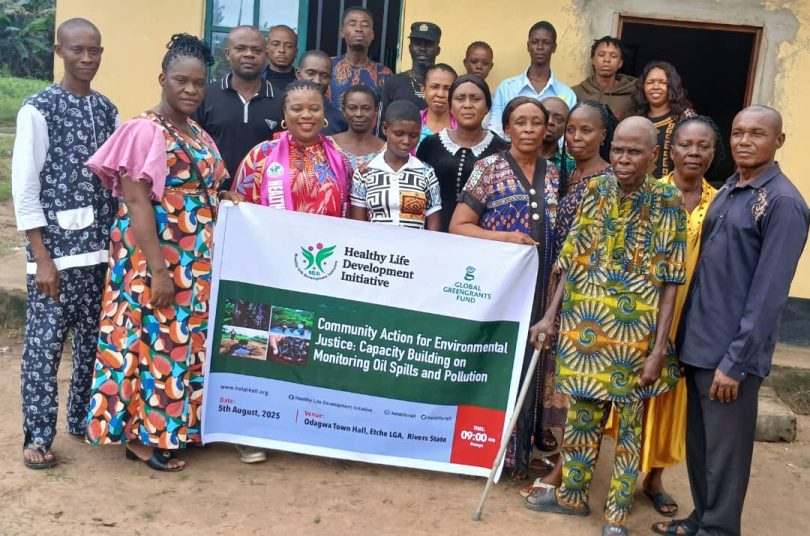
Fast-rising non-governmental organization, Healthy Life Development Initiative (HELDi) , has announced successfully conducting community capacity-building training in Odagwa, Etche LGA, Rivers State, South-South Nigeria.
This is as HELDi forays in the rural areas may have uncovered cause of high blood pressure in some rural areas of Rivers State where gas flaring is rampant.
The theme of the scheme is said to indicate readiness to fight for better environment with the theme: “Community Action for Environmental Justice: Capacity Building on Monitoring Oil Spills and Pollution.”
According to a statement endorsed by the Executive Coordinator, Dr Mfon Utin, the training was aimed at empowering residents to effectively monitor, report, and advocate against environmental pollution in their communities.
She said the intervention was organized in response to the alarming increase in environmental degradation in the Odagwa community, particularly waste burning, oil spills, gas flaring, and artisanal crude refining, also known as ‘Kpo-fire’, which continue to have devastating impacts on human health, livelihoods, and the ecosystem.
The session was facilitated by Dr. Utin, with interactive discussions on the different types of pollution experienced in the community. The session was said to have begun with participants sharing local examples and the visible impacts on their environment.
Key topics included oil spills, with emphasis on their causes, signs, and long-term environmental damage; gas flaring, with its effects on air quality, noise pollution, and public health; and artisanal refining, focusing on its environmental hazards, health risks, and economic consequences.
Through practical illustrations, real-life scenarios, and picture displays, participants were said to have learned how to recognize visible and invisible signs of environmental pollution, monitor pollution incidents effectively using community-based approaches, report cases to relevant authorities, civil society organizations, and environmental advocacy groups. They were required to document evidence systematically for accountability and advocacy purposes, and safely collect and store samples for further testing where necessary.
A field visit was conducted to observe pollution hotspots within the community, but the team was denied access to gas flaring sites by security personnel.
After the training, participants were divided into two groups for discussions and presentations to test their understanding. The first group, led by Mr. Stephen Onyeche and Mrs. Joy Bright presented on the monitoring of pollution, while the second group, led by Mrs. Ogbeti Doris Samuel and Mr. Nwordu Samuel A. presented on the reporting of pollution.
All participants were formally adopted as members of the Odagwa Community Pollution Monitoring Team, with Mr. Stephen Onyeche was appointed as the team coordinator.
The training deepened their understanding of why timely monitoring and action are critical. Residents also shared personal experiences, especially concerning gas flaring. Mrs. Ogbeti Doris Samuel reported that the flaring often produces loud noises and strong vibrations at night, making it feel as if a vehicle was about to crash into their homes, thereby disturbing their sleep.
This discomfort, she noted, may be linked to the high rates of hypertension and elevated blood sugar levels observed in nearly 80% of participants during a previous HELDi medical outreach. Mrs. Monica Agbam, among others, also shared experiences of oil spills affecting their farmlands.
Participants requested the contact details of relevant regulatory agencies, and HELDi promised to share them on the community monitoring platform.
Concerns were raised about the lack of action by government bodies when incidents are reported, and HELDi emphasized that members must never take the law into their own hands but should escalate unaddressed cases to HELDi or other credible NGOs for advocacy and follow-up.
Some participants raised the issue of stipends and mobilization support for the team, but HELDi said it clarified them on it as a voluntary community effort.
They also committed to conducting periodic awareness campaigns in the community to educate residents on the dangers of environmental pollution and their role as a monitoring team.
The team was also trained on reporting and documentation, and a template was provided to guide members in effective and consistent reporting, with step-by-step instructions on its use. The training ended on a highly motivated note, with participants expressing readiness to begin active monitoring and reporting immediately.
HELDi reaffirmed its commitment to supporting the Odagwa Community Pollution Monitoring Team to achieve a safe environment.
By equipping community members with the skills to monitor and report environmental violations, HELDi says it has continued to advance its mission of promoting a safe environment, healthy living, and environmental justice for all.
$$