
DR UDOFIA SIGNING CEREMONY 2026
April 28, 2026
Title:
• Signs MoU with Council for Regulation of Freight Forwarding in Nigeria.
By Ignatius Chukwu
The Institute of Export Operations and Management (IEOM) which has a training centre for export business value chain has been approved as training centre for freight forwarding profession in the South-South and South East. This is said to be first of its kind.
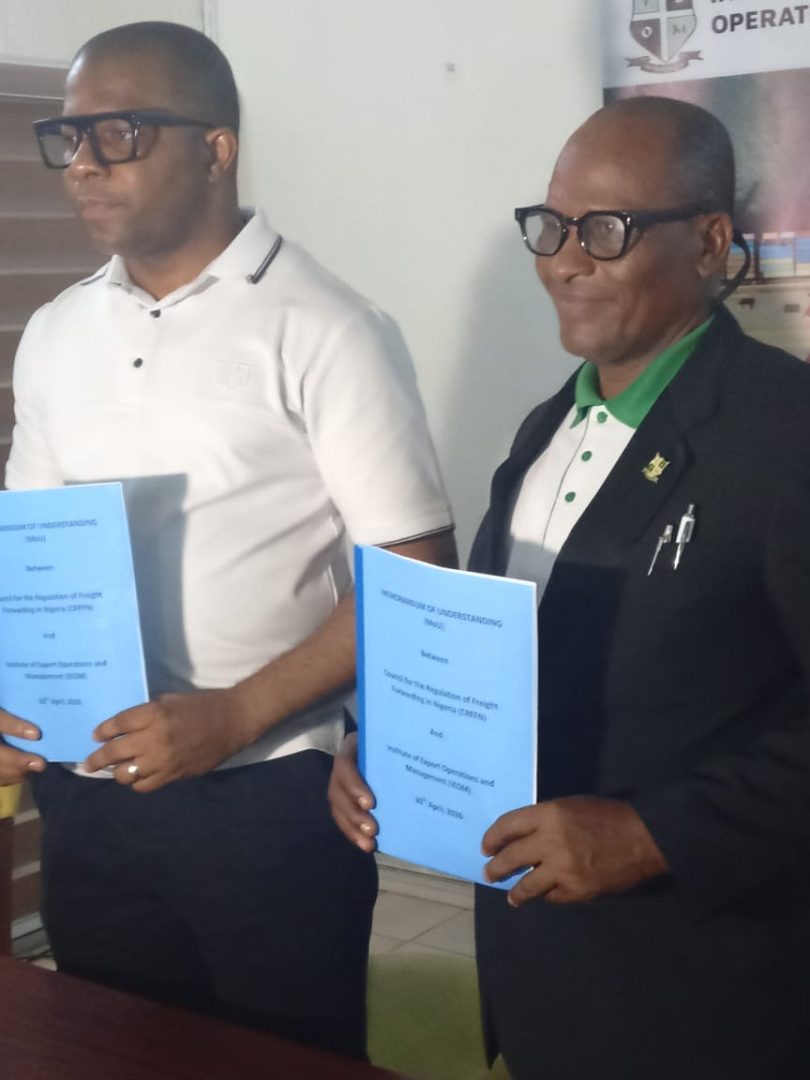
This became real after the signing of a memorandum of understanding (MoU) at the IEOM headquarters in Port Harcourt recently between Dr Kingsley Igwe, Registrar and Chief Executive Officer of the Council for Regulation of Freight Forwarding in Nigeria (CRFFN) and Dr Ofon Udofia, Executive Secretary and CEO of the IEOM.
The training is said to make practitioners strong as a freight forwarder, a custom broker, a warehouse operator, an air cargo consolidator, a consolidated freight station operator, a courier service operator, etc.
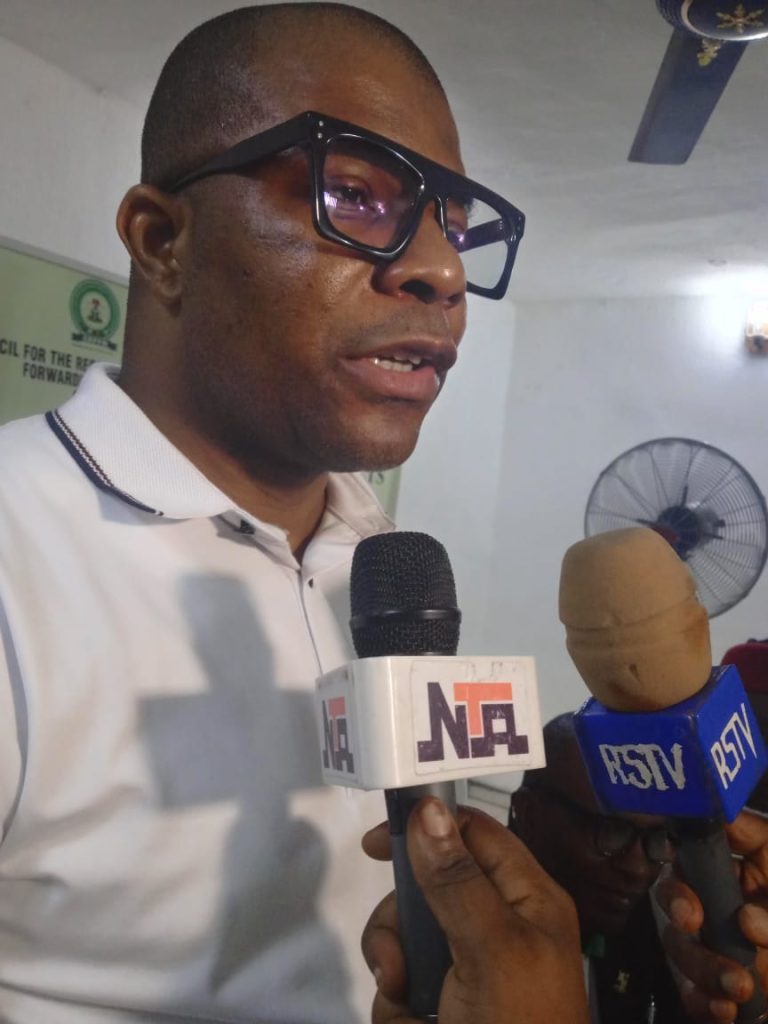
Speaking in a press briefing before the signing, Dr Igwe who said big things usually start small, said: “What we are doing today would be big in just one year. So the essence of our gathering today is to form this synergy, this collaboration, between the Council for Regulation of Freight Forwarding in Nigeria and the Institute of Export Operation Management in Nigeria. This means there is need for us to leverage on each other’s strength, because nobody has it all, and nobody knows it all.”
He said training is very important because a lot of people are in the freight forwarding industry that do not understand the language of the industry, not even the regulation guiding their actions.”
He said lack of training is also why most Nigerian products are being rejected during export, saying it is because they do not know the rules, and they don’t follow it. “This is because the practitioners are not exposed to the rules and the processes. And that is what brought this particular institution to limelight, for him to close that gap.”
He said the IEOM has crafted the items of knowledge in form of curriculum. “And that is what he’s using today to make impact in the industry. Absence of training is why there are many quacks in the industry.
“It is not because people do things deliberately. No, they do things ignorantly, thinking that they are doing the right thing. And that is why we are forming this collaboration today, in order to have practitioners around this region, the southern region, the Port Harcourt, River States, Enugu, just name it, all the states around this area, and even beyond, for people to be able to access this location and undertake the professional training that we are offering to the practitioners.
“Now, this training is going to help them because they are going to be certified. If you look at the industry, a lot of things have evolved.
“Overseas, you cannot practice in the industry without being professionalized, without being licensed, and without being trained. It is these elements that actually form you to be able to discharge the duty as a freight forwarder, a custom broker, a warehouse operator, an air cargo consolidator, a consolidated freight station operator, a courier service operator, just name it. Whichever aspect of the logistics service that you are rendering, it is through professionalism that you can be able to discharge that duty effectively.”
He pointed out another gap, saying because people do not know the service they are rendering, they do not know the deeper parts of it. “So knowledge is missing but they think they make profits because of the way they handle it. Unfortunately, they can make higher profits if they do it professionally.”
Custom brokerage, he said for example, “We are used to doing the normal runs and you know the very unconventional approach. If you understand the nitty -gritty of custom brokerage, HS classification, proper identification and classification of items by their HS code, you will be able to play around the tariff and still be able to, I mean, not to default.
“And this is where training is required. Without this training, you might not be able to effectively do classification. In the modern day Nigerian logistics industry is because we now have the national single window in place. It is not a place where you go and do permutation and combination anymore. You need to be clear on what you’re lodging because once you submit, that is it. And if you submit with error, that error follows through to the end.”
Dr Udofia opens up:
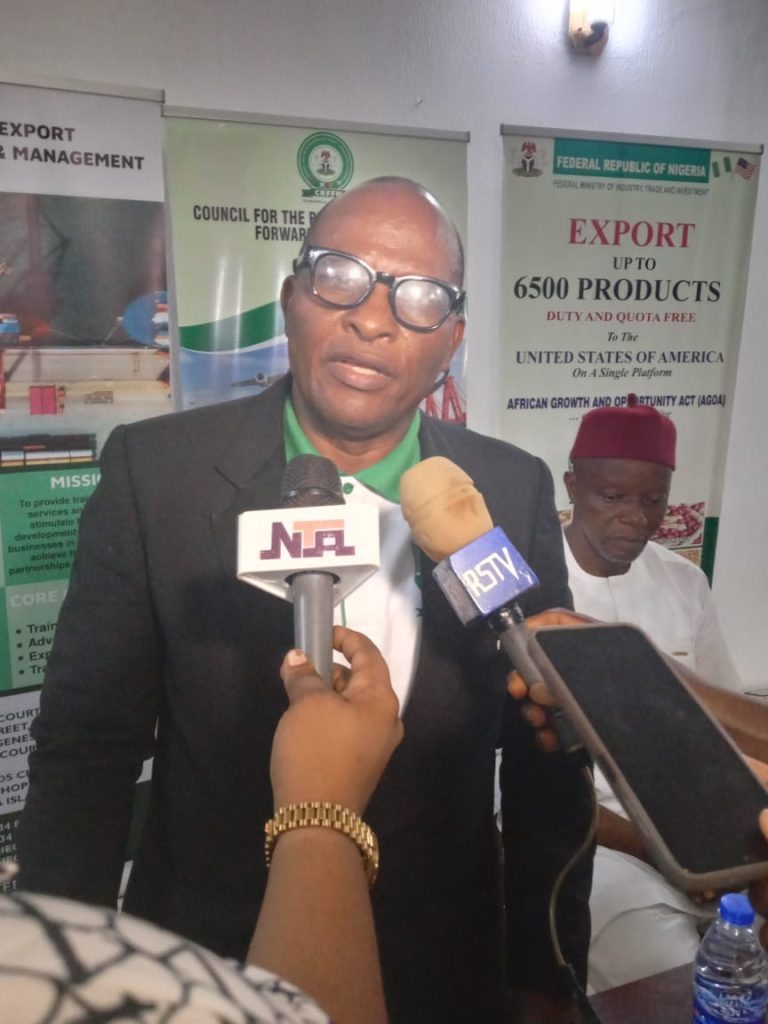
In export, we say when a product speaks for itself, you don’t interrupt that product, he has made a good speech. Today is not a speech-making day. It’s a day of action.
The Institute of Export Operations and Management, we are delighted to have this partnership, this marriage between our good selves and the Council of Freight Forwarders in Nigeria.
Our promise on this is, by the special grace of God, we do all we can, as we’ve been doing, to make sure that people are trained, midwifed, and held into the operations. He rightly said, the knowledge gap in this ecosystem is very wide. You don’t do what you don’t know.
There is no university in Nigeria offering export or trade forwarding as a course, so I am happy that we have come to this partnership to come up with a professional body that will certify people, not only just certify people, making them have confidence in themselves, making them proud of what they do, so that we will be able to attain what the president is talking about. We cannot get a $3 trillion economy without trade.
What we intend to do as an institute in collaboration with the council is, one, pass knowledge. Two, implement knowledge. Three, move knowledge. Four, see how we can use the knowledge.
Nigerians are not dubious:
Nigerians are too intelligent. If a young man can do yahoo successfully, getting money from people’s accounts, if such knowledge is transferred into meaningful things, transferred into clearing, forwarding of cargo, you will do more. So Nigerians are, as far as I’m concerned, are not dubious. They are honest. All they need is direction. So in conjunction with the Council, we are going to give the young people of this country, students, businessmen alike, a direction that you can do things right and still make your money, and then it’s more prestigious to do it that way.
So on that note, I will say that we sign the MOU, and then we say the board roll it. Thank you.
Implication of the MoU:
After the signing, the Registrar, Dr Igwe, explained how the IEOM is the only training centre in the region. He said they only did in-house training in their office but that has not been so anymore.
“When I came on board, one of my priority areas is training, training of the freight forwarders. I’m a product of training. I undertook a lot of training from advanced professionals.
“A lot of times when you hear about complaints in the port, we jump into conclusion that freight forwarders or customs agents are dubious. No, they are not. I am a living witness because I practice and have seen where the problems are.
“We have regulations, but these regulations are concocted and enacted and kept at the shelves in the offices. Those at the helm of affair have not been able to expose these regulations and knowledge areas to the users. They operate in ignorance.”
He said Dr Udofia is versatile. “He is not only telling you how to package products, those packaging itself has guided rules, you must observe, that is in line with international treaties and they are standardized, It’s not Nigeria that formulated it.”
He made it clear that the World Custom Organization is a regulator of HS Code and they have come up with a very nice structure, very simplified method of identifying or classifying items so that it is uniform across the globe. So whatever is identified with a code is same anywhere in the world.
“So now these people need to know what are those rules guiding this HS Code? How do you identify it? What do they mean? Each number represents something on that HS Code.
Challenges in the training:
I want to talk to the challenges in training as regard this region. You know, we were answering oil belts and we’re known for palm oil and the rest. And all of a sudden, during the advent of the crude oil, that actually spoiled this region because the IOCs were bringing people to receive training, paying their transport and feeding them so they got used to that.
So the major challenge we have is that people don’t want to pay for training. They don’t want to pay for services. So it becomes an issue because we are limited by guarantee, that’s social enterprise. We are not funded by government. So people are expected to pay for the training that they come for.
But the narrative is actually changing because a lot of people want to do export, so like what we did today, the people we trained today, they paid for their training. We took them to the port, showed them the Customs, took them to the terminal for them to really see the practical angle of it.
We have also tried to find a way to bring the training a little bit cheaper and easier by building an academy, what we call IOM Export Academy.
Under that academy, we have something for the youth and students, what we call Student and Youth Export Development Program. If you see Chinese people coming into Nigeria, they caught hem young at a very tender age to do things and export.
They are taught to export, not to import, so we want to imbibe that in this collaboration to make sure our students are taught how to export, our students are also made to understand that you don’t just carry your portfolio and go to the port and become a forwarding agent, that you need to be educated.
$$