

By Ignatius Chukwu
Many stakeholders have admitted that the Nigerian Export Promotions Council (NEPC) in the South-South zone with regional headquarters in Port Harcourt has been one of the foremost federal agencies doing their work without looking back.
They point to ceaseless training and availability of the best resource persons from anywhere in the country to handhold exporters and budding ones to success, such that no interested person can say support to excel was his or her problem.
Now, on Wednesday, September 30, 2026, NEPC in the zone led by Mrs Ngozi Ibe, brought together exporters once more for strategic training this time on packaging for export.
Details:
The Nigerian Export Promotion Council (NEPC) has launched packaging and compliance strategies to boost non-oil export in the oil region.
NEPC said packaging has emerged as one of the challenges facing exporters especially from the oil region, saying products from the region however command high demand at the international market.
To push for correct export practice in the oil region, NEPC mounted a one-day capacity-building workshop on ‘Packaging for Export’ at the Aldgate Congress Hotel on Abacha Road in the New GRA in Port Harcourt on Wednesday, September 30, 2026.
Explaining the criticality of packaging in export practice, Mrs Ngozi Ibe, the regional coordinator of NEPC in Port Harcourt, spoke on the theme: “Packaging for Export: The Regulations on Packaging — Packaging that Protects, Preserves and Promotes Your Brands.”
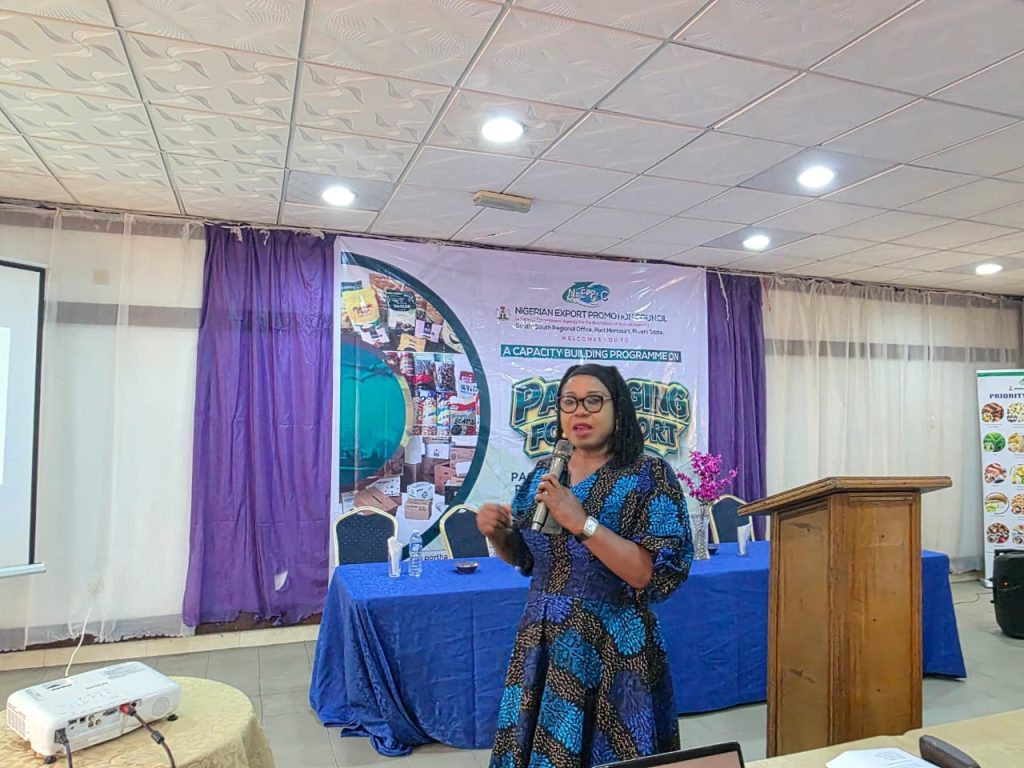
She showed how much harm that can come to export products caused by poor packaging.
She named some of the products from the oil region that make waves abroad such as palm oil and cassava, saying the products do not last a day at exhibitions abroad.
Mrs Ibe insisted that packaging should tell the story of the brands. “It should communicate quality, professionalism, authenticity, and value. When a product reaches an international shelf, the packaging should give the buyer confidence that the product meets the standards expected in the global marketplace.”
She reminded the exporters that a good product could lose its market opportunity if it was poorly packaged. “On the other hand, appropriate packaging can protect a product from damage, contamination, and deterioration; preserve its quality and shelf life; provide important information to consumers; and enhance the overall presentation and marketability of the brand.”
She mentioned efforts to expand Nigeria’s presence in international markets, but said: “We must recognize that packaging is much more than simply putting a product inside a container. Packaging is part of the product, part of the brand, and often the first impression a buyer has of what we are offering.”
For exporters, she went on, understanding packaging regulations and international market requirements is particularly important.
“We also need to move away from the perception that attractive packaging is only about aesthetics. Export packaging must be functional, compliant, durable, cost-effective and market appropriate. It must withstand transportation and handling while maintaining the integrity of the product from the point of origin to the final consumer.”
For the exporters, she said the call to action was simple: “Know the requirements. Check your packaging. Comply with the standards. Protect your product. Strengthen your brand. And take your products confidently to the world.”
Later in the training, the regional coordinator took the participants through the processes of packaging from understanding packaging to stages of packaging, the right materials, the designs, the spoilage factors, the regulations, functions of packaging, quality control, to the hygiene considerations.

“Let us remember that packaging protects, packaging preserves, and packaging promotes. When we get our packaging right, we are not only protecting our products—we are protecting our reputation, building buyer confidence and creating stronger opportunities for our brands in international markets.”
In his goodwill message, Kevin Nweke, permanent secretary, Rivers State Ministry of Commerce and Industry, who was represented at the workshop, announced that the Ministry has set minimum standards for packaging of products. He also said the Ministry encouraged value addition because, according to him, it could boost value of a product up to 300%.
He commended NEPC for consistently promoting non-oil export in the oil region.
In his own intervention, Engr Egbuna Iloba, zonal coordinator of the Small and Medium Enterprises Development Agency of Nigeria (SMEDAN), hailed the consistent collaboration they enjoyed with NEPC. He said non-oil export has increased very much due to the activities of NEPC.
In her brief remark, Mrs Nkechi Ezeworgu from the Port Harcourt office of the Standards Organisation of Nigeria (SON), made it clear that packaging, labelling, and compliance were key factors in export business.
Other regulatory bodies delivered lectures to the exporters to help them gain competence and confidence in export practice.