
• As youth restiveness and unemployment top security challenges in oil region
Solutions may be on the way to the youth of the oil region as the senate committee has held meetings in the region on way out.
Details:
Stakeholders in the South-South geopolitical zones have identified challenges militating against national security in the region, with strengthening community policing topping the list of solutions proffered.
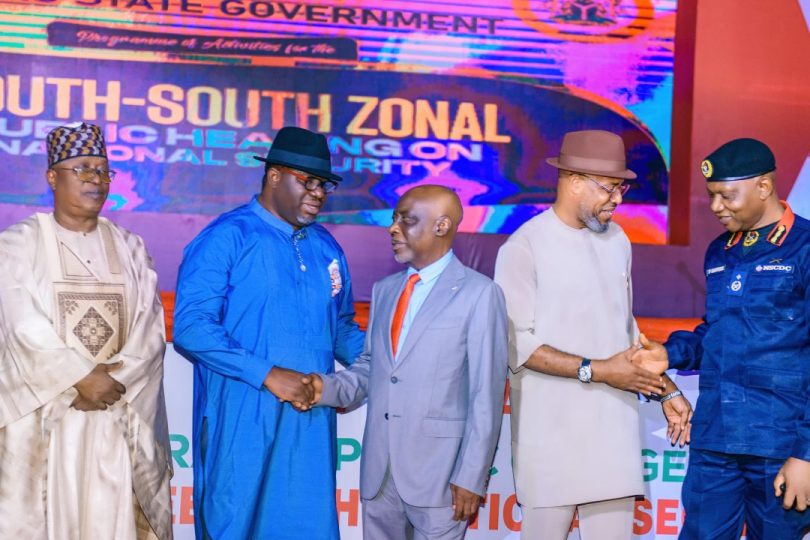
This was as the Senate Ad-Hoc Committee on National Security Summit, in collaboration with the Rivers State Government, held the ‘South-South Zonal Public Hearing on National Security’ in Port Harcourt on Thursday November 20, 2025.
The stakeholders, which include representatives of civil society groups, traditional institution and youth groups identified youth restiveness, resulting from the alarming rate of youth unemployment, as being at the root of pipeline vandalism and oil theft in the region.
Abba Moro, Senate Minority Leader and zonal chairman of the Senate Committee, in his address, said the summit is part of efforts to understand and collectively address the security challenges confronting the nation.
He described the summit as a unique platform for frank deliberations and assessments geared towards procuring probable solutions that will mitigate the security challenges of the country.
Moro said, “The Senate as a responsive lawmaking institution, recognises that no security act can succeed without a clear understanding of local dynamics and peculiarities of security occurrences across the country.
“We are here today to listen to security experts, traditional rulers, community leaders, civil society organisations and those directly affected by the very threats that this summit seeks to address.
“Be assured that the information we should gather from this summit would undoubtedly form the basis of our recommendations to the Senate, which will serve as guides to our legislative interventionist measures, budgetary provisions and policy reforms that will revamp national security landscape,” he said.
Moro added that the Senate “decided that we should hold it (public hearing) at the level of the geopolitical zones because most of the geopolitical zones have unique problems, have unique challenges of insecurity in their various communities. It is the opinion of the Senate that these views, these challenges must be understood from the base from which they arise.”
Siminalayi Fubara, governor of Rivers State, represented by Benibo Anabraba, Secretary to the State Government, noted that “Security is not the business of Government alone, but a shared responsibility and concern of every person.”
He called for greater collaboration among stakeholders in the South-South in order to ensure peace, security and development in the region, while stressing his administration’s commitment to securing lives and property.
Fubara said, “As a government, we are not unaware of our constitutional responsibility to ensure the protection and safety of lives and property in the state, including the territorial integrity of Nigeria.
“These objectives we have assiduously pursued with robust collaboration and partnership with the Federal Government and the various security agencies, in providing the necessary equipment such as operational vehicles, boats, and even aircraft, accommodation, and support, including the welfare of both serving personnel and the Nigerian Legionnaires.
“This summit could therefore, not have come at a better time, as it is today, in the face of security challenges in the region that drains our national revenue, damages our environment, and put lives and property at risk, and the immense efforts of the federal, state and local governments in combating these menaces to society.
“This distinguished gathering is a testament to our commitment and synergy towards a more secure, stable, and prosperous future for the South-South region and Nigeria in general.
“While we are happy to partner with the Senate Ad-Hoc Committee on National Security Summit in convoking this South-South Public Hearing on National Security, we urge the stakeholders gathered here to see this occasion as a mechanism from the people to the policy-makers, ‘Bottom-Up Approach, while giving special attention and recognition to our peculiar natural environment or topography as a coastal region that is the gateway to international waters of the Gulf of Guinea.”
Fubara assured that his administration will continue to partner security agencies to foster peace in the region, adding that “The government of Rivers State will continue to adopt proactive measures such as intelligence sharing, and best practices with security agencies and our brother states, complement security initiatives and state engagement, the employment and empowerment of youths, and public participation, particularly at community levels in line with the theme of the summit, ‘The Way Forward in Tackling National Security Issues at the Local Level,’ he said.
Stakeholders at the summit drew a correlation between good governance and insecurity. Civil society actors, monarchs and youth leaders tied insecurity in the Niger Delta to what they described as “hunger in the land” and the high unemployment figure among youths in the region.
They said efforts at tackling insecurity must start with good governance, employment creation, increase in the 3% for host communities as contained in the Petroleum Industry Act (PIA) and remediation of the Niger Delta environment degraded as a result of oil exploration.
They further asked onshore divestment by oil multinationals, such as Shell and Agip, be put on hold until they are made to remediate the region’s environment and ecosystem devastated by their oil exploration activities.
$$