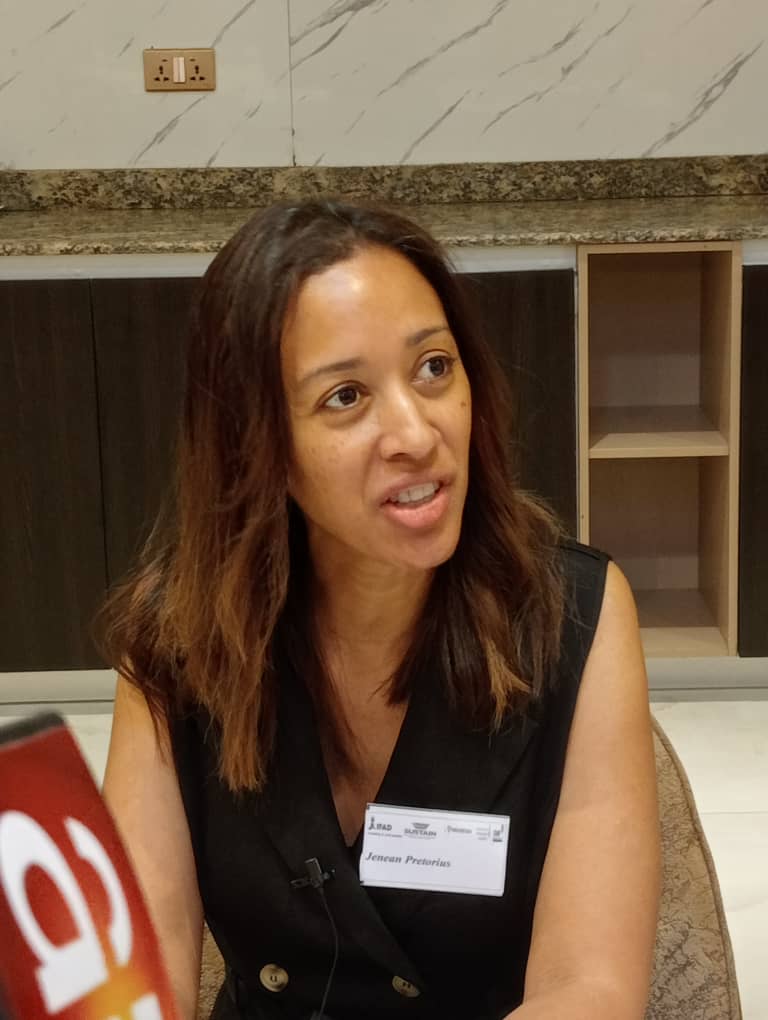

Jean Pretorius from South Africa was among resource persons that stormed Port Harcourt, Rivers State, South-South Nigeria, when the International Fund for Agricultural Development (IFAD) which is working in 59 countries in Africa and Asia to combat climate change harms, held a workshop in the city.
In Nigeria, IFAD is working with the Federal Government to tackle the most obvious harms of climate change which are identified so far as flooding, cessation of rains, or rains at wrong times. The task before the resource persons included training of experts to help cascade down the strategies in Nigerian states.
The training began in Port Harcourt on Monday, November 25, 2024. IFAD has partnership with the FG through the Federal Ministry of Agriculture & Food Security with which they created a special purpose vehicle called the Livelihood Improvement Family Enterprise in the Niger Delta (LIFE-ND) which has the Niger Delta Development Commission (NDDC) as a partner.
After the flag-off of the training at Villa Tuscana Luxe in the GRA 2 section of the Garden City, the South African sat down with newsmen to compare Nigeria with other countries involved in the project.
Details:
Jenean Pretorius
Clear-AA, University of Witwatersrand, South Africa; The centre for learning, evaluation, and results, Anglophone Africa.
Role in the workshop:
My role is in capacity strengthening. The centre is funded by the World Bank through the Global Evaluative Initiative. And so, we want to open up six international centres. We are based in Johannesburg, and we have been supporting the IFAD project through sustained grants. And through our partners, those that are based in Switzerland, we have been supporting this programme and this is the fourth country that we have rolled out in but we are the implementing partners supporting in Eastern and Southern Africa.
We just started in Nigeria, so we don’t have a sense yet of what is peculiar in Nigeria. But I think if we are to look at the previous countries where we have rolled out for IFAD such as Ethiopia, Malawi, and Rwanda, I would say its always challenging in terms of programme schedule. If we are to reflect on the training there and the combination where we had to travel to the project site in a rural irrigation project in Malawi. The experience shows that its usually jam-packed. In the three and half days, it’s always challenging because it’s never enough time to cover 10 modules. So, the way it’s being designed is a combination of theory and practical group work. This is to enable project managers to cover their schedule of work, it is for them to capacitated to roll up these projects. So, things like stakeholder engagements would be done and it would require going to the sites. The method involves bridging the contents that they receive in the class and then seeing how it plays out in the field. So, this is something that we were not able to do in all of the countries because, in Malawi for example, it was two hours drive, going and then two hours coming back. And then we squashed everything into the third day. It was really tight but we got such excellent feedback from the group saying that it made sense when they went onto the field. The engineer that led the programme said; “You know what, if we had this information long before, we could have done so much better”.
So, I think there’s definitely that kind of feedback at the end of each training. We have a feedback and evaluation form because we also want to learn what we can do better.
So, from the very first training that we rolled out in Ethiopia, we’ve improved upon that to see what we can do in terms of our learnings, in terms of making it more efficient, in terms of the knowledge that’s required because three and half days is very short. So we are looking forward to the learnings here in Nigeria and certainly I’m checking the projects and making sure that the applicability of what is taught is what is actually rolled out.
And who knows, there might be subsequent trainings and capacity development. And I think that they perfectly need it because once off training is not enough.
Gender complaints in Nigerian agric policy:
Our role is to bring everybody on board. When it comes to inclusion, and our role is basically to bring everybody together and ensure that the right people are in the right room. I think whatever issues and concerns that come up is important for policymakers to be aware of.
I think everything that rears up is reported at the end of every training. It is thus fundamental that these kinds of concerns should be included in the reports in order to influence policy makers and decision makers.
And I think even in the room here, one of the fortunate things is that you have the director of the department or the ministry as well, and I think whatever issues and concerns that come up, it’s important for policy makers to be aware of that. You know, we produce report at the end of every training, and so it’s fundamental that these kinds of concerns are included in order to influence the policy makers and decision makers; whatever those concerns are, whether they are about social inclusion, about gender, about youths’ inclusion.
I think there has been emphasis particularly from IFAD that such issues be brought in.
Probably, a lot more needs to be done, and I think through the petition systems and through the various grievance redress mechanisms.
It gives us such concerns to make sure we follow the chain of command. So, we agree that such concerns be taken note of and addressed at policy level in terms of inclusion.
$$