
• Institute of Export Operations and Management emerges only training centre in the region
IGNATIUS CHUKWU
Eradication of quackery in freight forwarding practice in the South-South and East kicks off as training of freight forwarders and others in the logistics industry soon to begin in Port Harcourt.
This follows a signing of a memorandum of understanding to permit the Institute of Export Operations and Management (IEOM) to begin the training. This is said to be first of its kind.
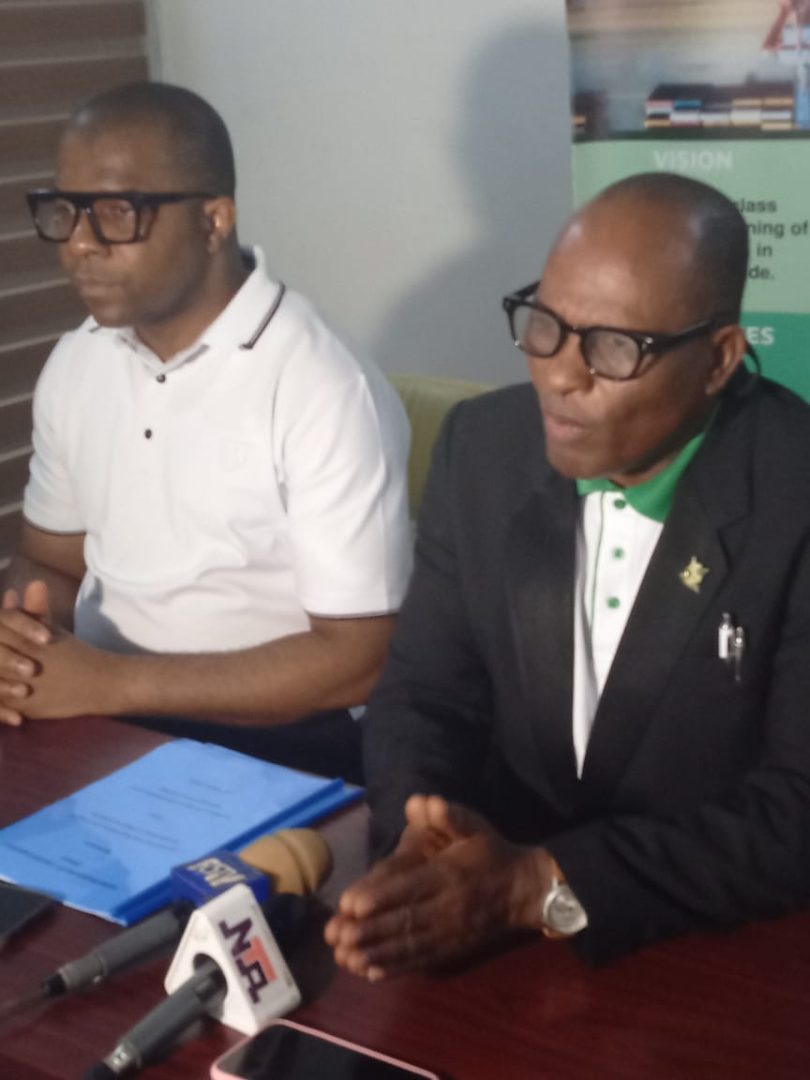
This became real after the signing of the MoU at the IEOM headquarters in Port Harcourt recently between Kingsley Igwe, Registrar (CEO) of the Council for Regulation of Freight Forwarding in Nigeria (CRFFN) and Ofon Udofia, Executive Secretary/CEO of the IEOM.
The training is said to make practitioners strong as a freight forwarder, a custom broker, a warehouse operator, an air cargo consolidator, a consolidated freight station operator, a courier service operator, etc.
Speaking at a press briefing before the signing, Igwe who remarked that big things usually start small, said: “What we are doing today would be big in just one year. So the essence of our gathering today is to form this synergy, this collaboration, between the Council for Regulation of Freight Forwarding in Nigeria and the Institute of Export Operation Management in Nigeria. This means there is need for us to leverage on each other’s strength, because nobody has it all, and nobody knows it all.”
He said training is very important because a lot of people are in the freight forwarding industry that do not understand the language of the industry, not even the regulation guiding their actions.”
He disclosed that lack of training is also why most Nigerian products are being rejected during export, saying it is because they do not know the rules, and they don’t follow it. “This is because the practitioners are not exposed to the rules and the processes. And that is what brought this particular institution to limelight, for him to close that gap.”
He said the IEOM has crafted the items of knowledge in form of curriculum. “And that is what he’s using today to make impact in the industry. Absence of training is why there are many quacks in the industry.
He stated: “Overseas, you cannot practice in the industry without being professionalized, without being licensed, and without being trained.”
He said quackery happens not because people do things deliberately. “No, they do things ignorantly, thinking that they are doing the right thing. And that is why we are forming this collaboration today to train those in the southern region.
“A lot of times when you hear about complaints in the port, we jump into conclusion that freight forwarders or customs agents are dubious. No, they are not. I am a living witness because I practice and have seen where the problems are.”
Speaking, Udofia, executive secretary of the IEOM, said the institute was delighted to what he called a marriage with the Council of Freight Forwarders in Nigeria.
He lamented at what he termed absence of any university in Nigeria offering export or trade forwarding as a course.
He said: “So I am happy for this partnership to come up with a professional body that will certify the trained persons, not only just certify people, but to make them have confidence in themselves. This will make them proud of what they do, so that we will be able to attain what the president is talking about. We cannot get a $3 trillion economy without trade.”
He rejected the notion that Nigerians were dubious, saying Nigerians were rather very intelligent.
He said time has come to transform the intelligence from negatives deployments such as ‘yahoo’ to positives ones such as professional freight forwarding, export buyers, forwarding of cargo, etc. “All they need is direction. So in conjunction with the Council, we are going to give the young people of this country, students, businessmen alike, a direction that you can do things right and still make your money, and then it’s more prestigious to do it that way.”
On challenges, Udofia said the people of the region had enjoyed free training with allowances for too long that they now expected to be paid to be trained. They hardly agreed to pay to be trained. He said it was caused by oil economy.
Udofia went on: “So the major challenge we have is that people don’t want to pay for training. They don’t want to pay for services. We are not funded by government. So people are expected to pay for the training that they come for.”
He admitted that the narrative is actually changing because a lot of people want to do export, so they now pay to learn.
“We have also tried to find a way to bring the training a little bit cheaper and easier by building an academy, what we call IOM Export Academy.
“Under that academy, we have something for the youth and students, what we call Student and Youth Export Development Program. If you see Chinese people coming into Nigeria, they caught hem young at a very tender age to do things and export.
“They are taught to export, not to import, so we want to imbibe that in this collaboration to make sure our students are taught how to export, our students are also made to understand that you don’t just carry your portfolio and go to the port and become a forwarding agent, that you need to be educated.”
$$