
By Amarachukwu Ugwu
They tell us Rivers State is sinking not just in statistics, but in the rising floodwaters swallowing our homes. When the rains begin, we don’t get warning, we get water. When the floodwaters rise, we don’t get rescue, we get stories. We keep repeating the same tragedy.
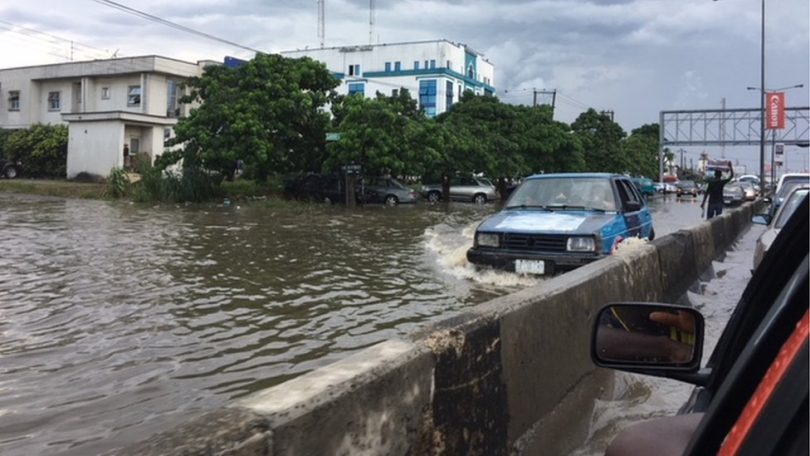
Rain started one night, then day after day of rainfall, and by morning my neighbour’s house was half under water. Streets in Obiri Ikwere, in Eleme, in Odiokwu, in Ubeta, they were no longer roads but muddy lagoons. Boats became the only way to move children to school, to reach the market, to carry the dying hope of what used to be a roof over someone’s head. Families lost everything: mattresses, foodstuffs, small businesses, school fees, all floating away. Two teenagers died in Obiakpor as a result of flood, people now sleep in other people’s rooms; some in public halls they turned into ad hoc shelters. Yet the government, as always, is quiet. Another season, another loss.
It is no news that a large part of Rivers State is low lying and close to sea level, near river banks, estuaries and creeks with high water tables. This geography amplifies flooding risk.
Beyond Port Harcourt, many communities drown every rainy season. Ahoada‐West Local Government Area was recently devastated: six communities Odiokwu, Ubeta, Obarama, Akinnima, Mbiama and Ula‐Ubie, were flooded in April 2025 after sustained downpours; whole households displaced. Rumuekini community in Obio/Akpor has been rendered homeless by floods before, after construction destroyed drainage during road expansion. Aluu, Ogbogoro and other Ikwerre adjacent communities have suffered similarly. In short, flood now spares few; misery is spread across local government areas.
Nigeria actually adopted the National Disaster Risk Reduction Framework in 2009, a policy that was meant to move us from reacting to disaster to preventing disaster: early warning systems, risk mapping, integrating disaster resilience into planning, and establishing institutions at state level (State Emergency Management Agencies) to coordinate preparedness, response, recovery. Sixteen years later, Rivers State does not yet have a fully functioning State Emergency Management Agency. No, there is no State emergency management agency in Rivers state. Plans were announced recently by the Sole Administrator to establish one, taking over from the Central Working Committee on Emergency Preparedness, Flood Management and Control. But announcements are not enough when season by season, lives are lost. Meanwhile, the democratic governor has been reinstated, will Siminalayi Fubara do anything different?
The failure is not ignorance. Engineers have produced drainage master plans. Researchers have mapped floodplains. Situational analyses exist. Policy documents are archived. Even warnings from NEMA and other national agencies show that about fifteen of Rivers’ LGAs are at high risk of flooding, that disaster displacement camps could be necessary. Yet what is our lived reality? Every time the skies open, people panic. Every time the water comes, no plan has kept our houses dry.
We must ask: Why do we only act when water is already in our living room? Why do we allow construction to block waterways, waste to clog drains, wetlands to be destroyed, all in the name of rapid development? Why do our leaders allow illegal structures, unregulated filling, and erosion to proliferate when the cost in human suffering is so obvious? And why is planning always behind the flood, never before it?
We need a shift in mindset from tolerating disaster as inevitability to planning for safety as a priority. Rivers State must give legal life to a State Emergency Management Agency with real funding, powers to enforce land use, prevent illegal construction, maintain drains, execute and monitor flood mitigation master plans. Early warning systems must reach every community, town sirens, radio, SMS alerts. Community education from primary schools to churches must teach risk awareness. Green infrastructure, trees, mangroves, preserved wetlands must be protected, perhaps even restored. Development must include drainage, elevation, zoning. Accountability must start now.
We are tired, but not powerless. We deserve a government that does more than issue promises after the water recedes.
On this International Day for Disaster Risk Reduction, Rivers must stop awaiting catastrophe. We must design for safety, build for resilience, act before we must react. When the next downpour comes, let it be tested not for our suffering, but for how far we have learnt.
Amarachukwu Ugwu is a Broadcast cum Solution journalist in Rivers state, Nigeria. You can reach her via Amarachukwuugwu518@gmail.com.