
By Ignatius Chukwu
The Economic and Financial Crimes Commission (EFCC) has explained why foreign nations and investors avoid countries perceived to have corrupt governments.
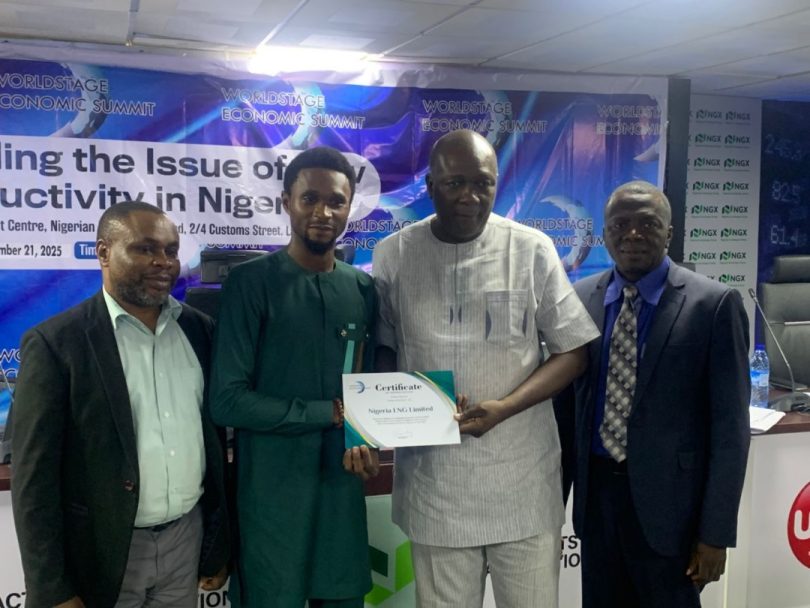
At the World Stage Economic Summit 2025 with the theme: ‘Tackling The Issue of Low Productivity in Nigeria’, Mr Olanipekun Olukoyede, Executive Chairman, Economic and Financial Crimes Commission (EFCC), said there is fear of distorted completion in such corrupt entities and countries.
Mr Olukoyede in his keynote address said it is an indisputable fact that corruption is not just a moral or legal issue; it is also an economic albatross that undermines productivity, discourages investment, and erodes public trust in institutions.
Indeed, he went on, every Naira lost to corruption translates to fewer schools, fewer hospitals, less infrastructure, and ultimately, fewer productive jobs.
Globally, he stated, investors have been found to consider the adverse effects of corruption on their businesses, so they try to avoid any perceived corruption-filled environment.
“The reason is not far-fetched: in any environment where corruption thrives, there is bound to be a distortion of competition, an increase in the cost of doing business, and a drag on innovation. Consequently, productivity inevitably declines.
“Therefore, tackling corruption is not only about enforcing laws; it is about creating a fair, transparent, and efficient economic ecosystem where legitimate enterprise can thrive.”
He said over the years, the EFCC has implemented consistent reforms and policies towards achieving a more effective role in economic governance.
“Since its establishment, the EFCC has been a key institution in Nigeria’s anti-corruption architecture. Our mandate is clear: to investigate, prevent, and prosecute economic and financial crimes.
“I urge you to take more than a passing interest in our cherished mandate, and you will be greatly thrilled to know that our mandate directly supports the ease of doing business and combats the root causes of low productivity.”
In recent years, he said, the EFCC has restructured their operations along three key lines: “Prevention: Strengthening systems to block leakages before they occur. Investigation: Leveraging technology and intelligence-driven processes for precision. Prosecution: Ensuring that those who abuse public trust face justice, with increasing emphasis on asset recovery and restitution.”
In addition, he said, coordination remains a core aspect of our strategy. “Statutorily, we have collaborated with both local and international organizations to enforce all extant laws and regulations relating to economic and financial crimes.
“These measures not only aim at punishing wrongdoing but also at improving the integrity of our economic environment. The EFCC has developed a framework encouraging corporate organizations to establish anti-corruption compliance programmes.”
He said they are working with the Corporate Affairs Commission (CAC) and the Nigerian Investment Promotion Commission (NIC) to ensure that ethical practices were integrated into business operations from registration to reporting.
“Collaboration with the Presidential Enabling Business Environment Council (PEBEC) to ensure that regulatory agencies operate transparently and that corruption does not undermine business reforms. Our joint task forces have addressed issues such as multiple taxation, bribery in public service delivery, and abuse of regulatory discretion.”
On use of technology and data analytics, he said the EFCC has has modernized their case management systems and introduced data-driven investigations using advanced analysis to track illicit financial flows. “This has improved response time and enhanced transparency in handling business-related complaints.”
The chairman said the EFCC has continued to collaborate with global financial intelligence units, such as the World Bank, INTERPOL, and the Financial Action Task Force (FATF) to strengthen cross-border financial integrity.
He also mentioned Asset Recovery and Restitution, but said the EFCC cannot win this battle alone. “Every sector represented here has a vital role to play. Integrity must become a national culture. When businesses refuse to pay bribes, when public servants reject inducements, and when citizens insist on accountability, we can collectively build a Nigeria where productivity thrives and poverty declines.”
He warned that the ease of doing business is not just about reducing bureaucratic hurdles, it is about building trust in the Nigerian system.
Segun Adeleye
In his welcome address, Segun Adeleye, the President/CEO, World Stage Limited, said the Nigeria’s economy has shown strong signs of recovery since 2024 when the first conference by World Stage took place. He said the economy was marked by significant gross domestic product (GDP) growth, increased foreign reserves, and a more stable foreign exchange rate.
He however said despite this macroeconomic recovery, challenges like high food inflation, widespread poverty, and the high cost of living persist for many citizens.
“Between WES 2024 and now, four major tax reforms were enacted, specifically in June 2025 to improve revenue collection; the combination of high inflation and a weakened currency has severely eroded household purchasing power; many households are struggling to afford basic necessities, leading to changes in consumption patterns, such as rationing food or seeking cheaper alternatives.
“The World Bank has projected cautious optimism, with growth expected to accelerate modestly in the coming years, assuming sustained monetary discipline and structural reforms.”
He said these indicators persuaded his group to choose the theme and focus of WES-25. “What we currently have is that while many are working, almost half of Nigerians are estimated to be poor, living below the national poverty line with multidimensional poverty at 63% and income poverty at 40%, just because the right jobs are not available.
“Flashing back again to our last year theme, if Nigeria’s economy is recovering, how do we get it to deliver higher productivity jobs to raise living standards?”
He noted that the discussion on low productivity should not lose sight of the government reforms like subsidy removal, exchange rate unification aimed to stabilize it; the macroeconomic reforms and tax changes to address these issues.
He went on: “As Nigeria’s real GDP grew by 3.19% in Q2 2024 and 4.23% in Q2 2025, some analysts project lower growth for 2025 due to factors like lower-than-expected oil production and insecurity.
“Interestingly, insecurity is attracting more attention in recent time, including from abroad. Insecurity in parts of the country negatively affects economic activity. Economic productivity will be a mirage without security.
“It will be helpful if the federal government can flow with the current momentum and grab the right strategy, including possible foreign assistance to finally end insecurity.
“With U.S President Donald Trump threatening to launch attacks Nigeria due to insecurity related issues, I believe our government can engage him and agree on joint military exercises that will flush out the terrorists, after all if Boko Haram has been existing since the Olusegun Obasanjo administration of 1999 to 2007 and we are yet to see the end of it till now, we don’t need anyone to tell us again that we need help.”
Adeleye said he hopeful that the outcome of the conference would become part of the valuable ideas needed to move the Nigeria’s economy forward.
$$