
By Ignatius Chukwu
Fresh from suspension, Gov Sim Fubara has picked on the ports in Rivers State as cause of the state’s economic setback. He said they are underutilization.
Exports have also tried to put the governor’s assertion in perspective, showing how exactly the ports have been underutilized.
Details:
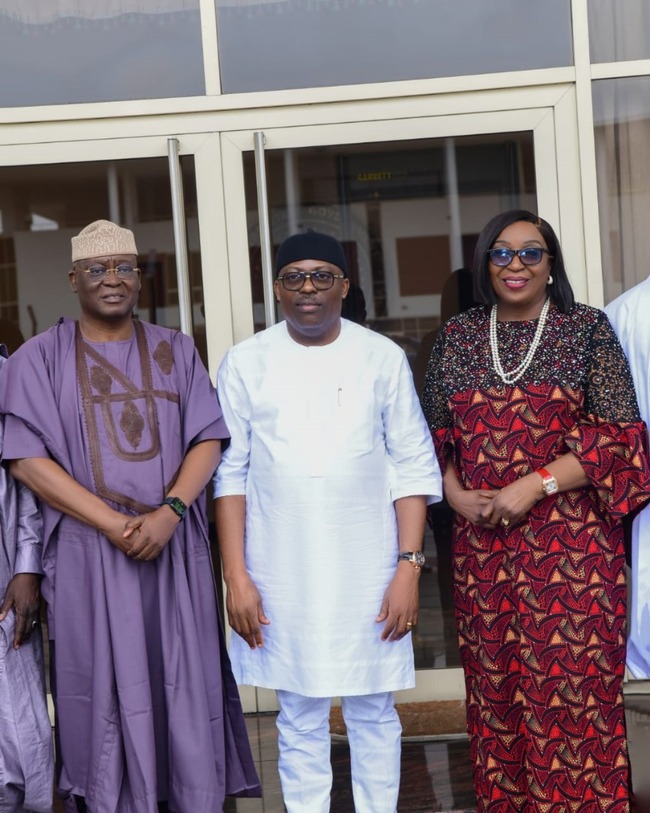
Gov Fubara used the opportunity of playing host to the board and management of the Nigerian Port Authority (NPA) in his office to point to what he called poor utilization of the Port Harcourt port.
The governor lamented what he called the economic losses suffered by the state and the nation. He warned that unless their capacities were fully harnessed, Rivers State and Nigeria would continue to miss out on jobs, investments, and industrial growth.
Experts in the field including Dr Ofon Udofia explained that the Port Harcourt Port, a river port, suffers underutilization due to neglect of the port since the war ended. A source said only 4 berths out of eight are under use because the other four under BUA Terminal have been turned into a factory site. Vessels allegedly queue to wait for turns to turn around.
For this reason, only one shipping line calls at the Port Harcourt whereas up to four call at Onne Port, Dr Udofia, Executive Secretary, Institute of Export Operations and Management (IEOM) said. “The truth is that the concessionaires were supposed to invest and rebuild the quays and other facilities but not much was done, and there seems to be little or supervision or insistence from the NPA and the Ministry of Transportation.
Now, Gov Fubara told a delegation of the NPA led by Sen Adeyeye Adebayo, chairman of the board, that seaports were essential to national development. He pointed out that many prosperous nations have relied on world-class ports and airports to power their economies. Fubara noted that despite Rivers State’s strategic advantage of hosting two major ports, their potential remained untapped.
He explained that if Onne port were operating at full capacity, the ripple effects on the surrounding areas-such as Eleme and Tai would be transformative. According to him, such a development would drive employment, stimulate manufacturing, expand clearing and forwarding services, and boost economic activity across the state.
The Governor maintained that maximising the ports would lower logistics costs, strengthen investor confidence, and attract industries that rely on proximity to export facilities. He added that the resulting growth would cut across job creation, business expansion, and increased tax revenues.
Fubara also pointed out that Rivers State enjoys a relatively peaceful environment, particularly under his administration, which he said has worked to foster stability and attract investments. He contrasted this with most other states where he said port activities were often disrupted by community disputes, stressing that Rivers maintains smoother cooperation among host communities, the government, and the NPA.
On infrastructure, the governor identified the dilapidated federal roads leading to the ports as a serious challenge. He said the poor state of the roads has led to flooding and traffic congestion. He called on the FG to prioritise their rehabilitation.
While recognising that such roads fall under federal jurisdiction, he assured that his administration would complement federal efforts through improved traffic management, better regulation of truck drivers, and the enforcement of order around port areas.
He further pledged to strengthen security in the port environment by facilitating the establishment of a police station within the facilities. The Governor linked insecurity to unemployment, noting that a fully functional port system would naturally reduce crime by providing alternative opportunities for young people.
Fubara condemned the encroachment of port lands by private individuals, warning that such practices undermine future development. He requested that the NPA provide comprehensive reports of such encroachment so the state government could intervene appropriately.
He also attributed much of the flooding around the ports to the poor condition of the access roads and inadequate drainage. He promised that once problem areas were identified, his administration would collaborate with the NPA on remedial works.
The Governor commended the NPA Board for engaging with the state government before embarking on intervention projects, noting that such collaboration would ensure sustainability and community acceptance. He urged the board to seize the current moment to revitalise the seaports so that they could become genuine engines of growth rather than neglected facilities.
In his remarks, Sen Adedayo described Nigeria’s litoral states as being richly endowed with marine assets that could drive economic prosperity. He assured that the NPA board was committed to optimising operations at the Port Harcourt and Onne ports.
He also sought the state government’s support in addressing key challenges such as rehabilitation of access roads, control of illegal truck parking, improved environmental sanitation, and the establishment of a police post to bolster security within the port precincts.
$$